Commercial EV charging utilization is quoted constantly and defined inconsistently, so the headlines need a careful reading. Utilization at destination sites, meaning multifamily, workplace, and hospitality properties in markets like California, the Pacific Northwest, and Colorado, is a different number, measured a different way, from the public fast-charging utilization figures that make industry headlines. This article keeps those two apart, because conflating them is how operators end up with the wrong expectation.
Two utilization numbers that get confused
The two utilization figures industry reporting quotes most often look like they should be comparable, and are not. They are measured against different denominators.
On the public side, the best-defined national figure comes from a named source. Paren's 2025 report put U.S. public DC fast-charging utilization at 16.2% in Q1 2025, rising to 16.4% by Q4, under Paren's stated tracked-time methodology. That is close to flat even as total sessions grew roughly 30% to an estimated 141 million in 2025, because new ports came online about as fast as demand grew (industry network data, as of Q2 2026). Regional spread under that average is wide: some dense urban markets ran above 30%, while low-adoption states sat in the low single digits.
Destination utilization figures are usually quoted against a different denominator: the hours that matter for the use case, such as evenings and overnight at an apartment building or weekday business hours at a workplace. A charger that is busy every weekday business hour is highly utilized for its purpose even though it sits idle nights and weekends. Occupancy of a relevant window, hours-in-use across the whole year, and energy throughput are three different measures, and they are not interchangeable.
The destination data gap
There is no destination-site equivalent of Paren's defined national measure. The utilization ranges that circulate for multifamily, workplace, and hotel charging come from operator anecdotes and vendor case studies that rarely name the operator, the sample, the geography, or the measurement definition, so this article does not quote them. When someone offers you a destination utilization number, ask who measured it, across how many sites, over what period, and against which denominator. A number that arrives without those answers is marketing, not data.
The same discipline applies to payback claims. Payback at a destination site depends on utilization measured in energy terms, the local tariff, the pricing model, and the incentive stack, and published claims that skip those inputs cannot be checked. Build payback from your own inputs rather than borrowing an unattributed range. A new site in a lower-adoption market should still expect lower utilization for the first 12–18 months while local ownership builds.
How to read a utilization number before you trust it
Utilization is reported inconsistently across vendors and case studies, which is why two sites with identical demand can quote very different percentages. Three questions separate a meaningful number from a misleading one.
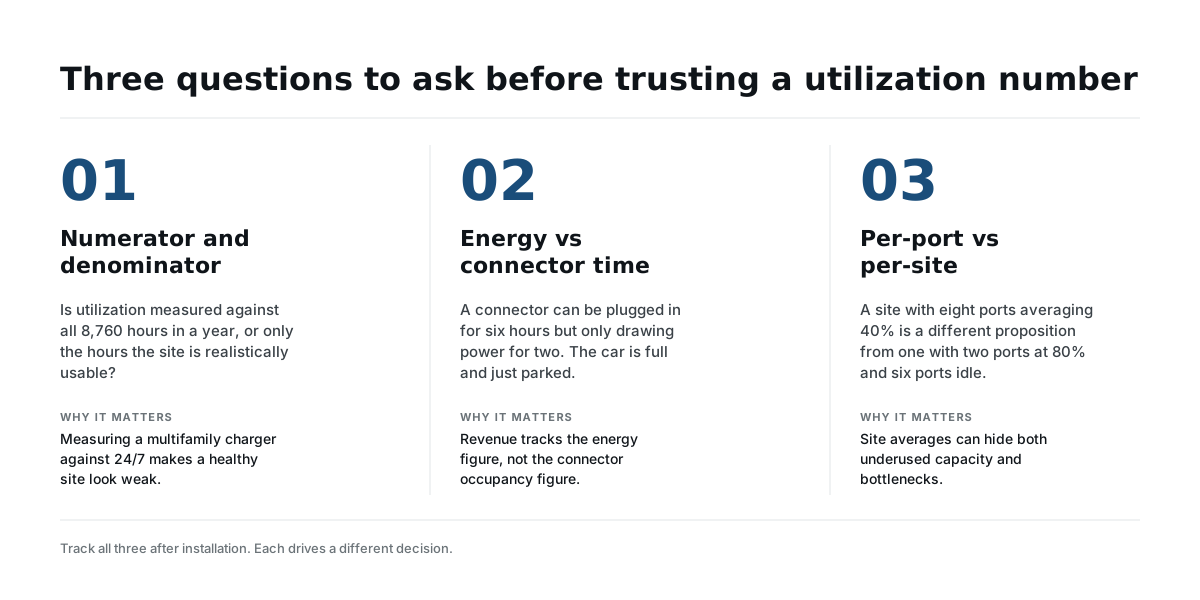
After installation, track all three on your own site. They drive different decisions: connector occupancy tells you whether to add ports, energy throughput tells you what revenue to expect, and the time-window denominator tells you whether the site is actually underperforming or just being measured unfairly.
The early-mover advantage
Properties that installed in 2020–2022, when local EV adoption was lower, are now benefiting from infrastructure they put in before demand matured. Operators considering installation today face higher equipment costs (partly offset by stronger incentive programs while they last) but also higher immediate utilization, because the local EV base already exists.
The contrast is sharpest in apartments: buildings with established charging command modest rent premiums in EV-dense submarkets, while buildings still planning are competing against an amenity they do not yet offer.
A closing incentive note
⚠️ Note: The federal 30C charger tax credit ended June 30, 2026. No federal EV charger tax credit is available for equipment placed in service after that date; budget the real out-of-pocket cost and look to state and utility programs.
Any payback you model should show its incentive assumptions explicitly. With the federal 30C charging credit now closed, the capital stack rests on state and utility programs where they exist. Model the no-incentive case as well, so the project still stands on its own economics.
What this means for earlier-stage markets
Markets at lower current adoption (parts of the Mountain West, much of the Midwest, several mid-Atlantic states) trail the high-adoption curve by a few years. The adoption and charging demand that California and Pacific Northwest operators are living today is a reasonable preview of where those markets are heading, but the timeline is a projection, not a promise. Installing now in a lower-adoption market is a bet on rising local ownership; size the project and the financing so it survives a slower-than-hoped ramp.
For the underlying revenue, cost, and utilization-sensitivity math at destination Level 2 sites, see Building a Realistic ROI Model for Commercial Level 2 Charging, which runs conservative, moderate, and mature utilization scenarios side by side. The public DCFC numbers above behave differently and follow a different model; see DC Fast Charging ROI: Why the Math Is Different for demand charges, NEVI dependency, and worked examples for corridor, retail anchor, and fleet depot sites.
California note: California's high adoption produces the strongest destination utilization, but its commercial demand charges and time-of-use tariffs (PG&E, SCE, SDG&E) raise the cost side. High occupancy helps spread fixed costs, yet a cluster of chargers drawing peak power simultaneously can trigger demand charges that erode the gains. Load management is usually necessary to convert high utilization into actual margin in California.
Last factually verified: 2026-08-11 against Paren's published 2025 U.S. public DC fast-charging utilization reporting and Public Law 119-21 (Section 30C).
Corrections (August 11, 2026): An earlier version of this article reported destination charger utilization of 50–70% at mature installations and operator payback of 3–6 years; both ranges were unattributed, with no named operator, sample, geography, tariff, pricing model, or measurement definition, and have been removed. The attributed public measure is Paren's 2025 report, which put national public DC fast-charging utilization at 16.2% in Q1 2025, rising to 16.4% in Q4, under Paren's stated tracked-time methodology; destination utilization is measured against different denominators and the two are not comparable.