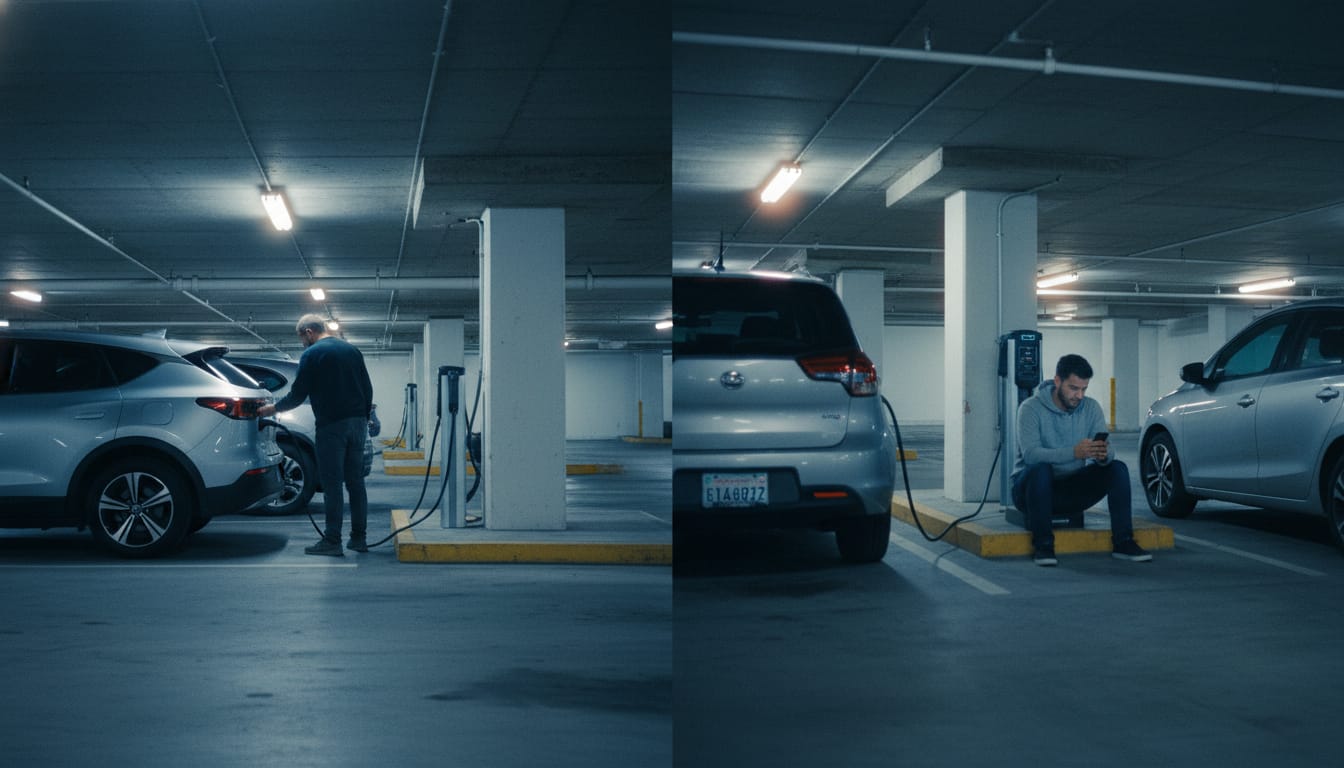
Whether EV charging infrastructure adds commercial property value is a question with a nuanced answer: it can, under the right circumstances, but the evidence is still developing and the effect is inconsistent across markets and property types. This article separates the part of the value argument that appraisers and buyers can underwrite today (capitalized income) from the part that is real but harder to price (amenity demand and competitive positioning).
If you want the full revenue-and-cost math behind the income figures used below, read Building a Realistic ROI Model for Commercial EV Charging first. This article picks up where that one leaves off: once you have a defensible net income number, what is it worth to the value of the asset?
The capitalization argument
The most straightforward property value argument: EV charging that generates net operating income (NOI) adds value at your property's capitalization rate. Direct capitalization is the standard appraisal method here, dividing stabilized NOI by the market cap rate to estimate value.
The math: suppose an installation generates $25,000/year in net income after electricity, network fees, and maintenance, and the property trades at a 5.5% cap rate (typical institutional cap rates ran roughly 5–7% across most stabilized asset classes as of Q2 2026, varying widely by market and property type):
$25,000 ÷ 0.055 = $454,545 in added value
The leverage in that formula is the point. At a 5.5% cap rate, every $1 of durable annual NOI adds roughly $18 of value. That is why the income approach, when it applies, can dwarf the raw cash payback of the equipment.
It applies cleanly only when:
- The chargers generate measurable, documented revenue
- The revenue is sustainable, not driven by one-time factors
- The operating costs are well understood and netted out
Why the income argument is weaker than it looks
The challenge is that the formula rewards stabilized NOI, and most commercial EV installations do not produce significant positive NOI in years 1–3 while utilization builds. A property sold before utilization matures will not realize the full capitalized value, because a buyer underwrites the income they can see in the rent roll and operating statements, not the income you project.
Two more cautions:
- Cap rate sensitivity cuts both ways. The same $25,000 of NOI is worth about $357,000 at a 7% cap rate and about $500,000 at a 5% cap rate. The value contribution is a function of the asset's cap rate, not a fixed dollar figure.
- Buyers discount thin, new income streams. A two-year revenue history at low utilization invites a buyer to haircut the number or capitalize it at a higher rate than the building's blended cap rate. Documented, stable revenue is what survives due diligence.
The amenity and tenant-demand argument
In markets where EV ownership is significant (coastal metros, college towns, affluent suburbs), charging is becoming a baseline amenity expectation for certain tenant categories. This shows up as reduced vacancy, lower turnover, and modest rent premiums rather than as a line item of charging revenue.
Multifamily: Renter-preference survey data supports real, if modest, demand. The public materials of the National Multifamily Housing Council and Grace Hill 2024 Renter Preferences Survey (2023 fieldwork, 172,703 respondents) found 4% of renters owned an EV or plug-in hybrid, 12% planned to purchase one, and 35% were considering one, alongside renter dissatisfaction with current charging access; the survey's willingness-to-pay tables sit in the paid report, so no publicly stated dollar figure is available and we do not quote one. More recent industry surveys report interest climbing toward roughly one-third of renters (as of Q2 2026; figures vary by survey and market). Separately, industry sources note that only about 5% of U.S. rental properties offered EV charging as of 2025, so the supply gap is real even where demand is. See Multifamily EV Charging Is Now a Lease Renewal Factor for how this plays out at renewal.
Office: Tenants with EV-driving employee populations include charging availability in office-search criteria. This shows up more in headquarters and tech-company leases than in typical office deals.
Hotel: Travelers who plan road trips by EV explicitly look for hotels with Level 2 charging. This is documented in review data and booking behavior on EV trip-planning platforms.
The amenity argument is real but difficult to isolate. It shows up in survey data and qualitative feedback more reliably than in matched-pair transaction analysis. Treat survey-based interest as directional evidence of demand, not as a guaranteed rent increase you can underwrite at full value.
Translating amenity premium into value
The amenity case can be larger than the direct charging revenue, but it has to be counted deliberately. A worked illustration (illustrative, not measured):
| Input | Value |
|---|
| Units with a captured rent premium | 8 |
| Premium per unit per month | $40 |
| Annual premium income | $3,840 |
| Less vacancy/collection allowance (5%) | $3,648 net |
| Capitalized at 5.5% | ~$66,000 of value |
That figure is only credible if the premium is actually being collected and shows up in the rent roll. A projected premium that tenants have not yet paid is a leasing hypothesis, not NOI.
Formal, peer-reviewed research isolating EV charging's effect on commercial property value is limited. Residential studies tend to show cleaner results, with charger-equipped homes selling somewhat faster and at modest premiums in high-adoption markets. On the commercial side, most evidence is operator-reported and survey-based rather than drawn from matched-pair sales. We flag that distinction rather than paper over it.
What practitioners and brokers in active markets consistently report:
- Multifamily properties with robust charging in markets like the Bay Area, Seattle, and Denver are cited by tenants as a deciding factor
- Office properties courting tech and professional-services tenants differentiate on EV infrastructure
- The absence of charging at older multifamily properties has become a negotiating point in lease renewals
These are directional signals from the field, not transaction-level proof of a value premium.
Timing and market maturity
The value impact is greater in high-adoption markets today and will expand to mid-adoption markets over time. A property in a market where 15% of households own EVs has a far larger addressable tenant and buyer pool affected by charging than a market at 3%.
Installing today in a 5% market is a bet on where that market will be in 5–8 years. Properties that already have infrastructure when demand matures avoid retrofit costs and can come to market with a differentiated offering. That option value is real, but it is not capitalizable income, so keep it out of any NOI figure you present to an appraiser.
What buyers and appraisers actually value
Current market practice varies:
- Some buyers capitalize documented charging NOI straightforwardly
- Many appraisers treat EV infrastructure as an amenity warranting comparable adjustments, not a precise income capitalization
- In sale-leaseback and institutional transactions, EV infrastructure is increasingly documented in the due-diligence package
- Sustainability frameworks (LEED, ENERGY STAR, GRESB) credit EV charging, which can affect institutional buyers' ESG scoring and, indirectly, pricing
How to maximize the value contribution at sale
- Document actual revenue, utilization, and operating costs for at least 12 months. Trailing data beats projections in every underwriting conversation.
- Separate durable income from one-time incentives. A buyer capitalizes recurring NOI; they do not pay you a multiple for a tax credit you already claimed.
- Present value conservatively: the lower of capitalized income or a comparable-property amenity adjustment. Overstating it invites a discount on the whole package.
- Keep the equipment serviceable and the warranty/maintenance records clean. Deferred maintenance on chargers reads as a liability, not an amenity.
California note: California's high EV penetration makes the amenity case strongest in the state, but it also raises the operating-cost side of the NOI calculation. Commercial time-of-use and demand charges on PG&E, SCE, and SDG&E tariffs can materially reduce the net income you capitalize, so use your actual rate schedule rather than a national average before converting revenue into a value estimate.
The honest summary: EV charging can add commercial property value, the income approach is the part you can defend, and the amenity premium is real but should be priced with restraint until you can show the rent roll to back it up.
Last factually verified: 2026-05-24 against the public NMHC/Grace Hill renter preference survey summary, published commercial cap-rate ranges, and direct-capitalization appraisal methodology. The survey's willingness-to-pay tables are in the paid report and are not quoted here.