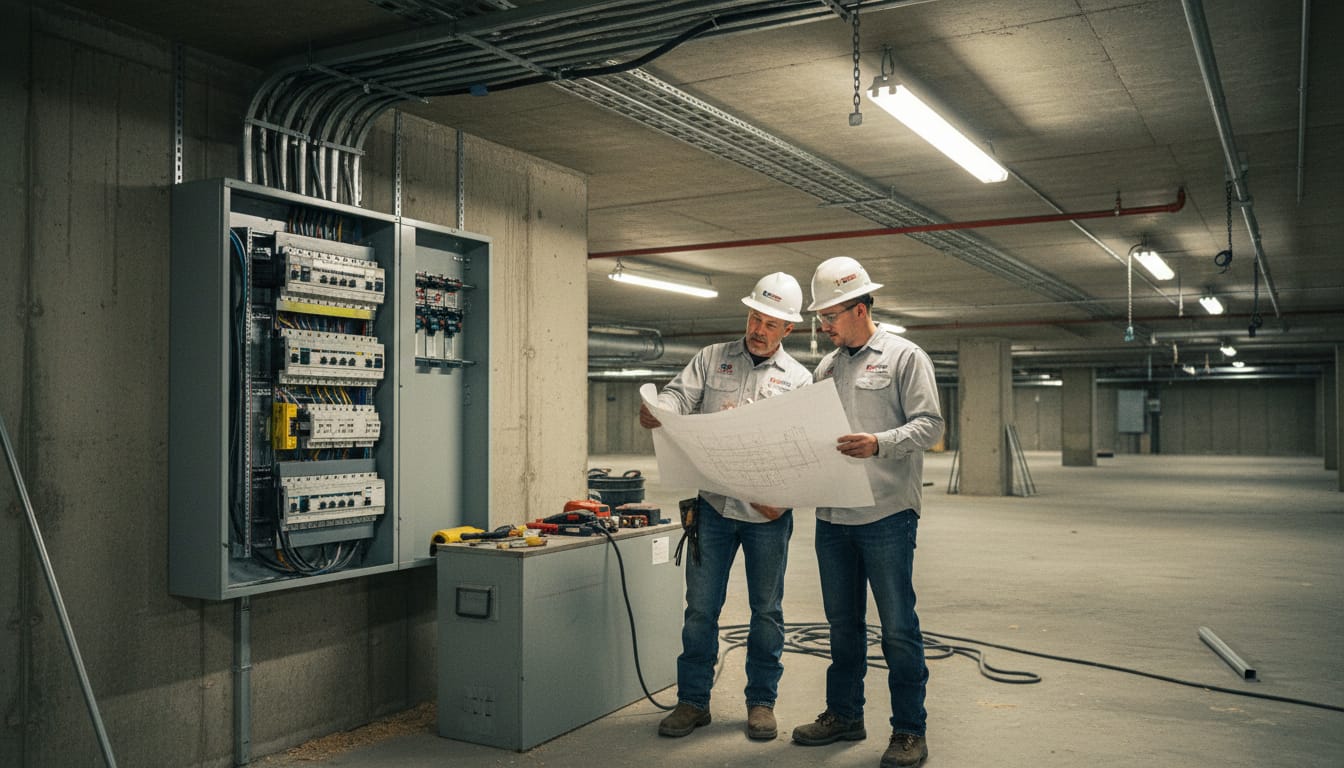
The most expensive EV charging mistake a commercial owner can make is building infrastructure that is hard to expand. Conduit that is too small, panels sized exactly for current load, hardware locked to one vendor's ecosystem: each of these creates retrofit costs that can exceed the original install. Future-proofing is not gold-plating. It is spending a little more on the cheap, hard-to-change parts so you spend much less on the expensive parts later.
Here is what future-proofing actually means in practice, in the order it matters.
⚠️ Note: The federal 30C charger tax credit ended June 30, 2026. No federal EV charger tax credit is available for equipment placed in service after that date; budget the real out-of-pocket cost and look to state and utility programs.
With the federal credit gone, future-proofing is a pure infrastructure decision rather than a tax-timing one. The most economical version of "build for the future" is still to capture as much make-ready infrastructure as possible while a project is already underway: oversize conduit and panel capacity now so that adding chargers later is a wire pull rather than a re-trench. The 30C credit is no longer a factor in that calculus, so size the infrastructure to your real demand projection and let build timing follow the project's own economics. See Stacking Incentives for how state grants and utility rebates interact.
Oversize conduit on day one
Conduit work is labor-intensive and disruptive. Once it is buried in concrete or asphalt, re-running it means cutting and patching. The conduit material itself is a small fraction of the labor to place it, which is why oversizing it is one of the highest-return decisions in the project.
Standard practice: install conduit sized to pull three to five times the circuits you need initially. This adds little material cost and essentially no extra labor. When you add chargers later, you pull new wire through conduit that is already in the ground.
Specifically:
- Installing 4 charging circuits now: run conduit sized for roughly 8 to 12 circuits
- Installing 10 circuits: run larger conduit or multiple parallel runs
- Install pull boxes at key points to make later wire pulls practical
- Document the routing precisely (photos, measurements, as-built drawings); you will need it
The retrofit cost of adding conduit later commonly runs two to four times the original infrastructure cost (rule of thumb, as of Q2 2026). The oversizing premium is small by comparison.
Size sub-panels for future load
Sub-panels serving charging should be sized for anticipated eventual load, not the initial install. Putting in a 100-amp sub-panel for a 40-amp initial deployment, when you will eventually need 200-plus amps, means replacing the panel and its wiring when you expand.
The incremental material cost to step up sub-panel capacity at install is small relative to the cost of swapping a panel out after the fact, which carries its own labor, downtime, and re-permitting (illustrative, as of Q2 2026). Size up once.
Main service: if your main service cannot support eventual full charging load, understand that constraint before committing to a site or build-out plan. Utility service upgrades are expensive and slow. As covered next, load management can often defer or permanently avoid them.
Implement smart load management from the start
Load management treats your available electrical capacity as a shared pool, dynamically allocating it across active chargers. When one car finishes, the freed capacity routes to another that needs it. When demand is high, each charger gets somewhat less, but no car is shut out.
Why this is a future-proofing tool: without load management, every new charger needs dedicated capacity. With it, you can install more chargers than your raw capacity would support at theoretical maximum simultaneous draw, because true simultaneous maximum almost never occurs. A panel that naively supports two full-power chargers can often support five or six under load management.
The practical effect is that you add charger hardware as demand grows while deferring (sometimes indefinitely) an expensive service upgrade. That is exactly the kind of decision that protects you from both under-building and overspending.
Require OCPP compliance
OCPP (Open Charge Point Protocol) is the open standard for communication between chargers and network management software. OCPP-compliant chargers can connect to any compatible platform, not just the manufacturer's proprietary one.
Why vendor lock-in is a real risk: charger makers have discontinued products and gone out of business. When a proprietary network goes dark, the hardware often loses its smart features (scheduling, monitoring, billing). OCPP-compliant chargers can move to an alternative platform when that happens.
For commercial properties: require OCPP 1.6J or later in all charger specifications, and treat OCPP 2.0.1 support as a plus. This is standard RFP language, a baseline requirement, not a premium feature. Verify the specific models you are quoting are genuinely certified, since "OCPP-capable" claims vary in completeness.
Plan for the NACS connector transition
The connector landscape has consolidated around NACS (standardized as SAE J3400) alongside the legacy J1772 and CCS ecosystem. Most new EVs from 2026 onward ship with a native NACS port, while a large installed base of CCS and J1772 vehicles remains on the road, so this is a multi-year hybrid period rather than an overnight switch (as of Q2 2026).
For new Level 2 installations: specify hardware with replaceable or swappable connector cables where available, so you are not locked to one connector for the life of the unit. For DC fast charging, plan for NACS connectors, with CCS coverage as the installed base warrants. Ask vendors about cable retrofit or upgrade programs as standards evolve; the ability to change a cable rather than a whole unit is a meaningful hedge.
A future-proofing checklist
- Conduit sized for 3 to 5 times the initial circuit count, with pull boxes
- Sub-panel sized for eventual load, not initial load
- Main service capacity assessed against full build-out
- Load management specified from day one
- OCPP 1.6J or later required in writing, models verified as certified
- Connector strategy that accounts for the NACS transition
- Complete as-built documentation captured at handover
Document everything
Accurate as-built documentation is routinely neglected and expensive to recreate later:
- Conduit routing (photographs, measurements, CAD where available)
- Panel schedules with breaker labeling
- Charger serial numbers and firmware versions
- Network credentials and software platform access
When staff turn over, documentation keeps institutional knowledge from walking out the door. When you expand, accurate as-builts mean you are not paying someone to rediscover what is already in the ground.
California note
California owners get a head start on future-proofing because CalGreen and Title 24 already mandate EV-ready conduit and capacity in much new and renovated construction, so a meaningful share of the make-ready work may be required regardless. High commercial electricity rates and time-of-use structures also make load management more valuable in California, since shaping when and how fast chargers draw power affects both demand charges and energy cost. Treat code-mandated make-ready as a floor, not a ceiling, and size beyond it where your demand estimate justifies it.
Last factually verified: 2026-05-24 against the SAE J3400 (NACS) standardization record, Plug In America and ChargeRight 2026 summaries of the Section 30C credit and its June 30, 2026 expiration, Qmerit and EVB 2026 cost guidance, and the 2025 CalGreen code summary.