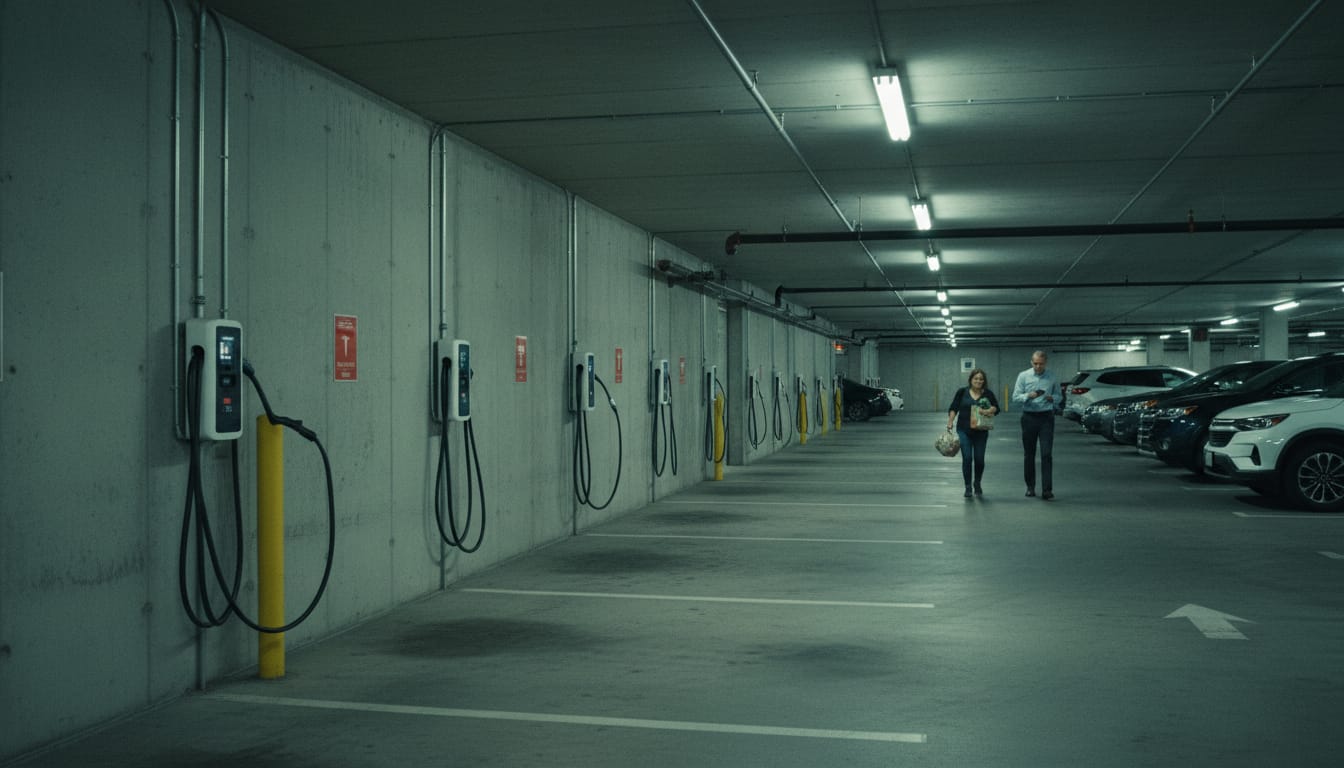
Where you put chargers on a commercial property matters as much as which chargers you buy. Poor site selection raises installation cost, depresses utilization, and creates compliance problems that are painful to fix later. These decisions are some of the most expensive to reverse in the whole project, because once conduit is buried in concrete or asphalt, moving it means cutting, re-trenching, and patching.
This article covers the five factors that should drive site selection, in roughly the order of their impact on cost, plus how to run the walkthrough that catches the problems paper analysis misses.
Before booking a site visit: Check the existing public charger density around your property and the local EV registration count. A market that is underserved relative to local EV ownership is a stronger candidate for a new installation than one that is already saturated. Open the public charger density lookup →
Factor 1: Proximity to electrical service
This is the dominant cost variable, full stop. Running electrical infrastructure (conduit, conductors, switchgear) costs largely as a function of distance and the surfaces it has to cross. Chargers 20 feet from the panel cost a fraction of chargers 400 feet away across a parking lot.
What to assess:
- Where is the main electrical panel or transformer?
- Is there an intermediate sub-panel closer to the target parking?
- What is the realistic cable route: through existing conduit, along building exteriors, or underground?
- Does the route cross anything expensive, such as asphalt requiring saw-cutting, landscaping, structural penetrations, or a drive aisle that has to stay open?
Rule of thumb: placing chargers near existing electrical infrastructure can cut installation cost meaningfully (commonly cited in the range of 40 to 70 percent versus a remote location; illustrative, varies by site, as of Q2 2026). When two parking areas are otherwise equivalent, proximity to power usually decides it. This single factor is why a "worse" parking location can be the right financial choice.
Factor 2: Parking flow and visibility
Chargers that are hard to find do not get used, and chargers in inconvenient spots get passed over for closer non-EV parking. Utilization is the variable that drives revenue, so visibility is not cosmetic.
Good locations:
- Near building entrances, which shortens the walk for users
- Visible from the main circulation path through the lot
- Compatible with clear signage (overhead markers, tall signs)
- Near where users naturally spend time (lobby, elevator bank, an amenity)
Problematic locations:
- Back corners of large lots
- Poorly lit areas, which also raise safety concerns
- Spots that require navigating past the main parking area
- Loading zones or areas with competing uses
For destination charging (hotels, shopping centers), placing chargers near the entrance also signals that charging is a valued amenity rather than an afterthought, which influences whether guests choose you over a competitor.
Factor 3: ADA compliance
Federal ADA standards require EV charging spaces to comply with accessible-parking requirements, which affects both how many accessible EV spaces you need and where they sit.
The key requirements (confirm current specifics during design):
- A share of EV spaces must meet accessible dimensions, typically a wider space plus an adjacent access aisle
- Accessible EV spaces must sit on the shortest accessible route to building entrances
- The 2010 ADA Standards currently apply; EV-specific federal guidance has been in development, so design to current state accessibility code as well
If your most electrically convenient location cannot accommodate ADA-compliant spaces on an accessible route, you have a conflict to resolve at design, not after installation. This is exactly the kind of issue that turns a cheap site into an expensive one. See ADA Requirements for EV Charging for specifics.
Factor 4: Future expansion capacity
Most commercial installations start smaller than they will eventually need to be, and EV adoption in your market will likely grow over your hold period. Planning for expansion now is far cheaper than retrofitting later.
What to think about:
- Is the conduit route sized to pull additional circuits later without new trenching?
- Is the panel or sub-panel sized for more load than the initial install needs?
- Is the parking area physically expandable for more stalls?
The make-ready approach: experienced operators install conduit and sub-panels sized for future build-out during the initial work, even when only some positions get chargers at first. Adding chargers later then needs only hardware and a connection, not fresh conduit. The incremental cost of upsizing conduit during the original trench is small; the cost of re-trenching later is commonly two to four times the original infrastructure cost (rule of thumb, as of Q2 2026). Factor 4 is therefore mostly a Factor 1 decision made early.
Factor 5: Dwell-time alignment
Level 2 chargers deliver roughly 10 to 25 miles of range per hour, so the location should match where users actually spend that time. NREL research puts the average Level 2 session around 50 minutes (as of Q2 2026), which underscores that Level 2 belongs where stays run in hours, not minutes.
| Use | Dwell-time fit for Level 2 |
|---|
| Office and workplace | Strong (full-day parking) |
| Hotel guest parking | Strong (overnight) |
| Multi-hour retail (grocery, home improvement) | Good |
| Restaurant and quick-service | Poor (too short) |
| Airport long-term parking | Strong |
If your users do not stay long enough for Level 2 to add useful range, you either move to DC fast charging (much higher cost) or accept that this location is not optimized for charging and look elsewhere on the property.
A site-selection scorecard
For each candidate location, score these and compare:
- Distance from power and route difficulty (the cost driver)
- Visibility and walking distance from the entrance
- Whether ADA-compliant spaces fit on an accessible route
- Room and conduit headroom for future expansion
- Dwell-time match for the users who park there
The best site is rarely the one that wins every category. It is usually the one that scores well on power proximity and ADA feasibility while staying visible enough to get used.
The site walkthrough
Before finalizing any decision, physically walk the proposed location with three perspectives present:
- A licensed electrician who can assess cable routes and real infrastructure cost
- Your architect or space planner for ADA and accessible-route review
- Your property manager or operations staff who understand actual parking flow
Together they surface problems a drawing hides. A site that looks ideal in CAD may have a buried concrete footing blocking the cable route, a grade change that complicates the accessible route, or a drive aisle that cannot be closed for trenching. Catching that on foot, before commitment, is the cheapest insurance in the whole project.
California note
California owners carry an extra layer: CalGreen and Title 24 set EV-ready and accessible-EV-space requirements for new and renovated buildings, and California accessibility code can exceed the federal ADA baseline. Treat the ADA factor as a code-compliance gate during design, and confirm current state requirements with your architect rather than relying on federal standards alone.
Last factually verified: 2026-05-24 against NREL Level 2 dwell-time findings, the 2025 CalGreen code summary, In Balance Green's ADA and EV charging guidance, and Qmerit commercial installation cost guidance.