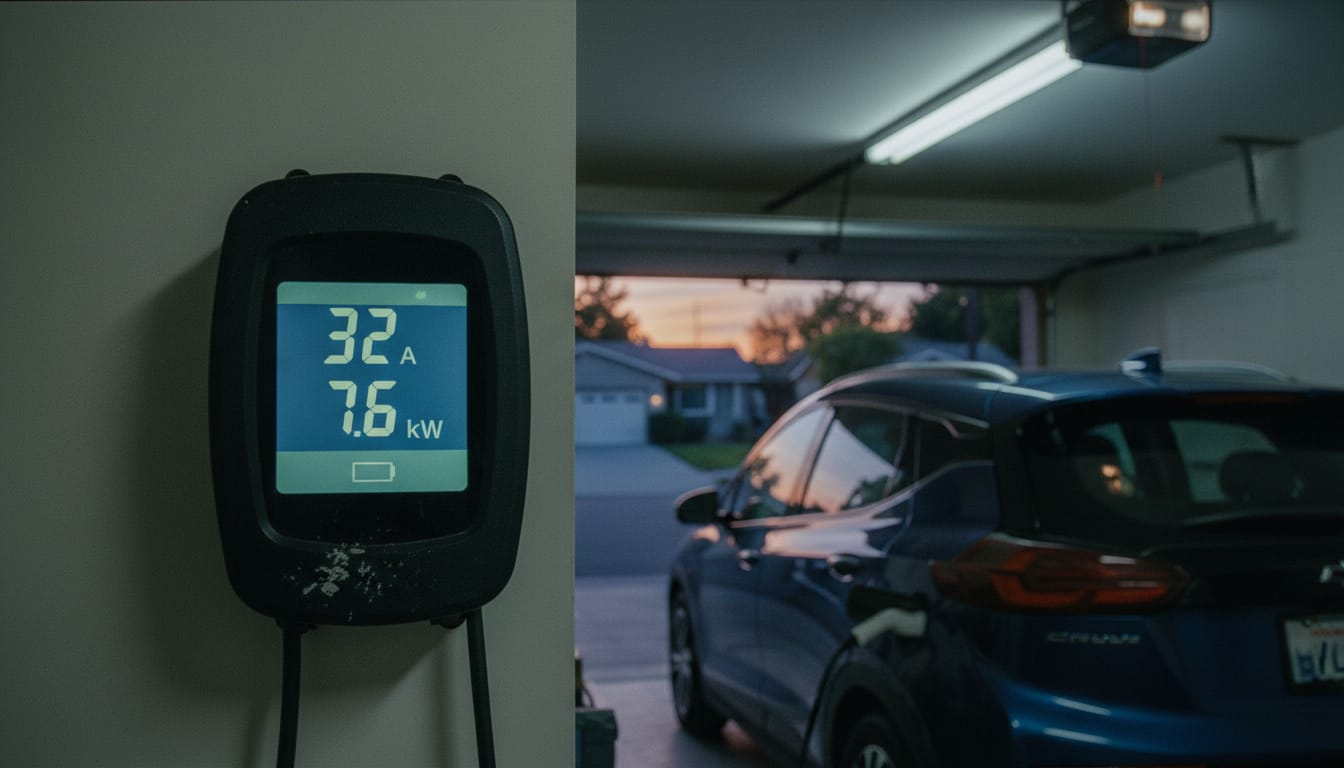
Charger listings put amperage front and center, 16A, 32A, 40A, 48A, because bigger numbers sound better. This article translates those numbers into charging speed, explains how they drive the size of the circuit you have to install, and shows why the highest rating often makes no difference for the car in your driveway.
How amperage becomes charging speed
The arithmetic is simple. Power in watts equals amps times volts, and a U.S. Level 2 circuit runs at roughly 240 volts.
- 32A × 240V = about 7.7 kW
- 40A × 240V = about 9.6 kW
- 48A × 240V = about 11.5 kW
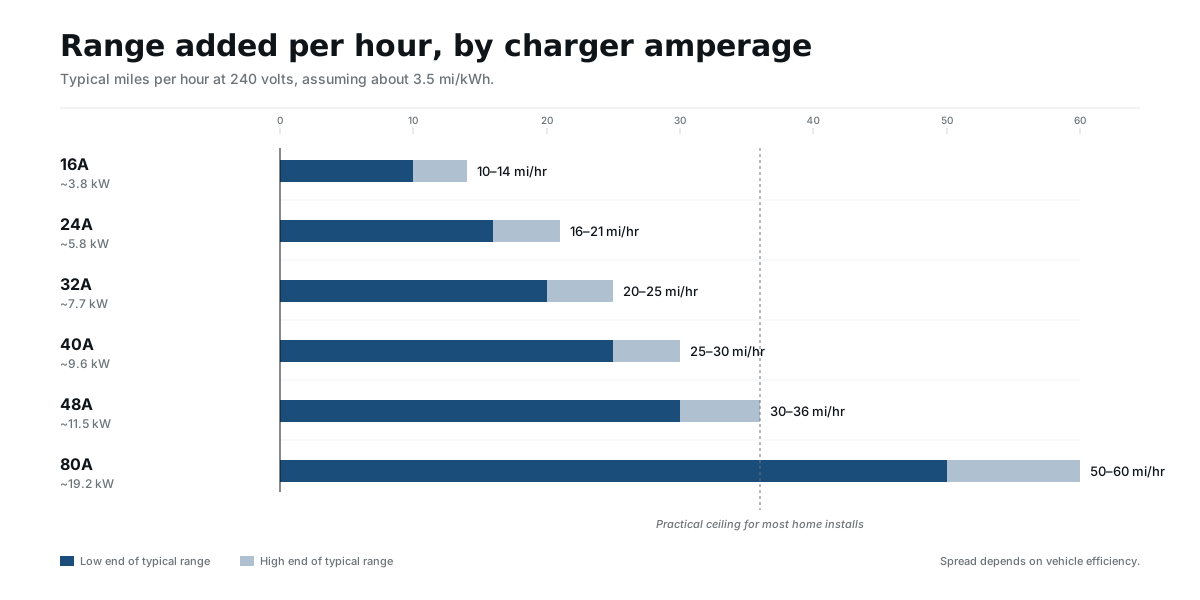
A useful rule of thumb is that a Level 2 charger adds somewhere between 3 and 4 miles of range for each kW delivered, depending on how efficient the car is. That gives the range-per-hour figures below.
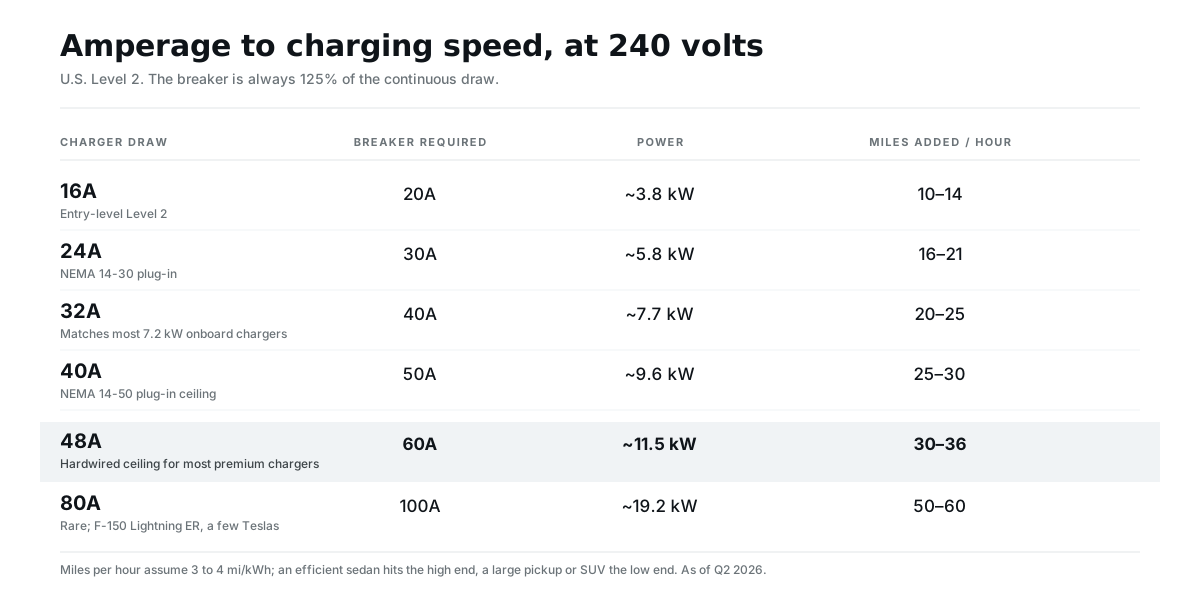
Miles per hour are approximate and vary with the vehicle's efficiency, battery temperature, and state of charge. Treat them as planning estimates, not guarantees. Plotted side by side, the diminishing returns above 48A on most homes become obvious:
The 80% rule, or why a 48A charger needs a 60A breaker
Under the National Electrical Code, EV charging equipment is treated as a continuous load, meaning it can draw its maximum current for three hours or more without a break. NEC 625.41 generally sizes EVSE feeder and branch-circuit overcurrent protection at not less than 125% of maximum load; 625.42 governs EVSE rating and managed limits, and the 2026 NEC separately changed service and feeder load-calculation treatment in Article 120. The inverse of that 125% rule, the version most people repeat, is the "80% rule": a charger may draw no more than 80% of the breaker's rating on a continuous basis. The 125% EVSE overcurrent rule appears across the widely adopted 2020/2023 framework and the current 2026 text, but related GFCI, load-calculation, and installation details vary by locally adopted cycle.
That is why the breaker is always larger than the charger:
- A 32A charger goes on a 40A circuit (32 is 80% of 40).
- A 40A charger goes on a 50A circuit.
- A 48A charger goes on a 60A circuit.
- An 80A charger needs a 100A circuit.
The reason is heat. Every connection point generates a little heat from resistance. With brief loads that heat dissipates between cycles; with a car drawing near maximum current for eight hours overnight, it accumulates. The 125% margin keeps conductors and terminations within their safe temperature range.
This matters for your wallet because the breaker size drives the wire gauge, the conduit, and sometimes whether your existing panel can take the circuit at all. Going from 40A to 48A is not just a charger choice; it is a heavier circuit and a panel-capacity question.
The bottleneck most guides skip: your car
Here is the part that decides everything. Every EV has an onboard charger, a component inside the car that converts the AC power from your wall into the DC power the battery stores. That onboard charger has a maximum input rate, and it caps your speed no matter how large the wall unit is.
Common onboard charger limits (check your own car's spec sheet):
- ~3.3–3.6 kW (older or entry vehicles): tops out around 11–14 miles per hour. A bigger wall unit does nothing.
- ~7.2–7.7 kW (a very large share of EVs sold): tops out around 20–25 miles per hour, roughly what a 32A charger delivers.
- ~11.5 kW (Ford F-150 Lightning, several others): can use up to about 48A.
- ~19.2 kW (some Tesla and a few others with the high-power option): can use up to about 80A.
If your car has a 7.2 kW onboard charger, a 48A wall unit charges it at exactly the same speed as a 32A unit. The car is the bottleneck, not the wall. Before you buy, look up your vehicle's onboard AC charging rate in kW; it is in the owner's manual or the manufacturer spec page.
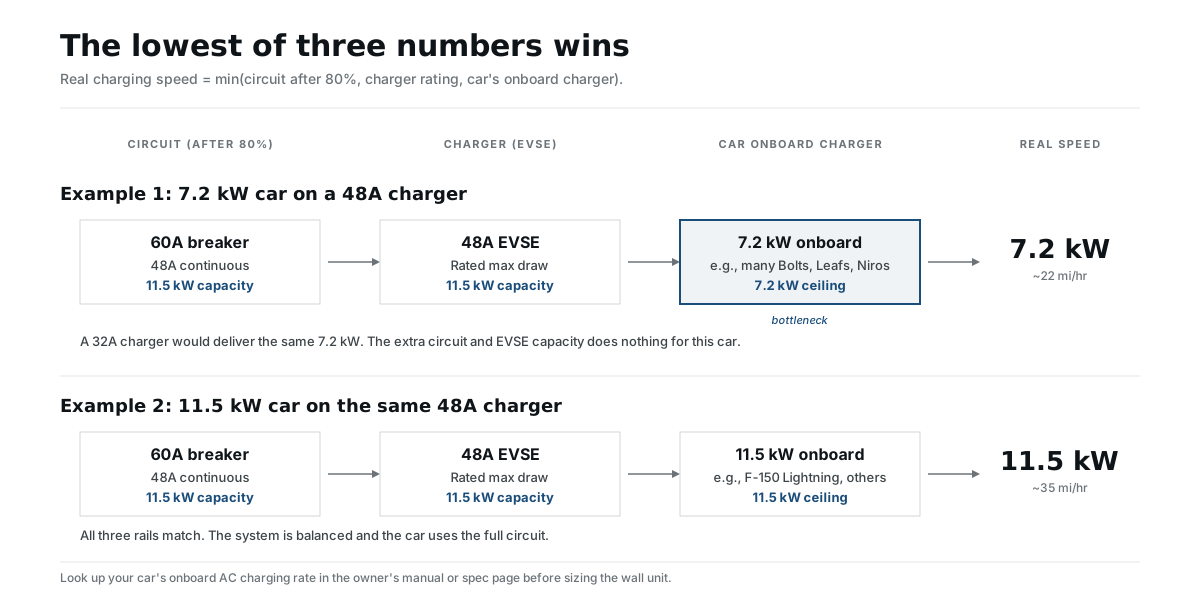
Worked example
A driver with a 7.2 kW onboard charger commutes 40 miles a day and parks from 6 p.m. to 7 a.m.
- At ~7.2 kW the car gains roughly 22 miles per hour, so it replaces a 40-mile day in under two hours.
- Buying a 48A charger instead of a 32A one changes nothing: the car still accepts only 7.2 kW, and both finish the same overnight refill with hours to spare.
The extra amperage would only matter if the same person later bought a vehicle that accepts 11.5 kW or more.
What amperage to buy
Match the charger to your car's onboard rate. The full mapping, with the circuits each pairing requires:
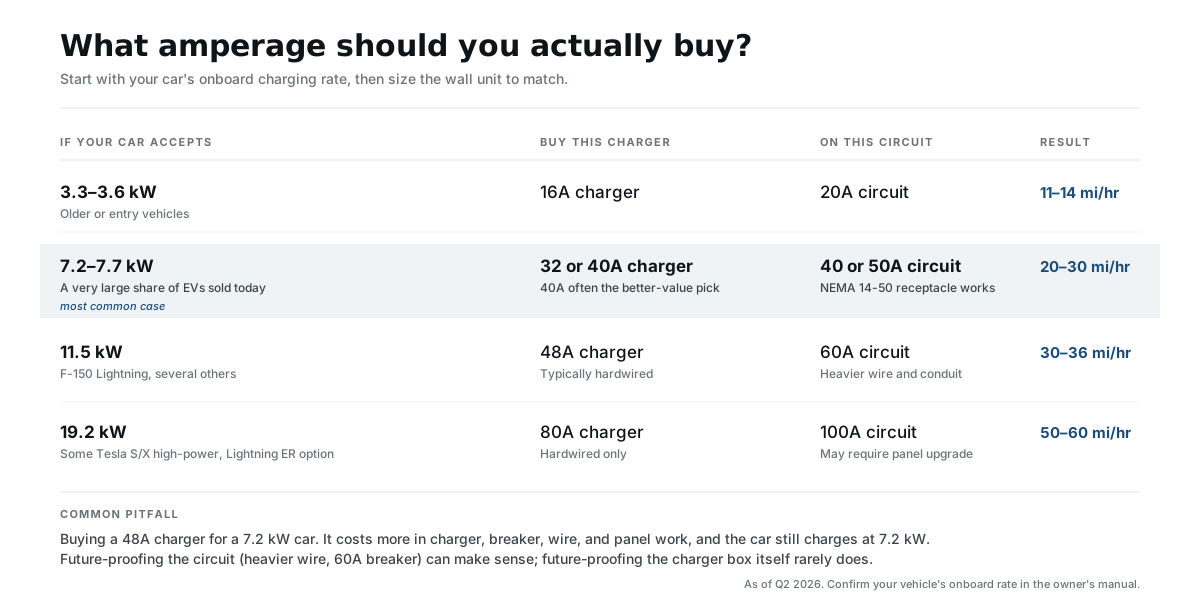
For the common 7.2 kW case, a 32A charger delivers everything the car can take, a 40A charger adds a small buffer for little more money, and a 48A charger is more than the car can use today; its only value is preparing for a future, faster-charging vehicle. For genuinely high-capacity vehicles (many Rivian, F-150 Lightning, Tesla S/X with the high-power option), a 48A or higher charger is worth it, because these cars actually use the power.
Does future-proofing justify higher amperage?
The case for buying more amperage than you need: you might own a faster-charging EV someday, and swapping a charger is a hassle.
The case against: the expensive thing to future-proof is the circuit, the wire, and the panel capacity, not the charger box. If you install a 40A (50A breaker) circuit now and later get a vehicle that wants 48A, you have to upgrade the circuit anyway, and at that point the charger swap is the cheap part.
A sensible middle path for many homes: install a 50A circuit with a NEMA 14-50 receptacle and use a 40A plug-in charger. The 40A draw covers nearly every vehicle sold today, the receptacle stays put if you change chargers, and you have avoided the heavier 60A circuit that a true 48A setup requires. If you are confident a faster vehicle is coming, run a 60A circuit from the start and hardwire a 48A unit; the marginal cost is far lower during the original install than as a later upgrade.
California note (as of Q2 2026): Some California utility rebates and managed-charging programs require a networked charger and may specify a minimum charging level. The amperage that qualifies for a rebate can differ from the amperage your car can use, so confirm program rules before sizing the circuit. See the smart-features article for detail.
The short version
Look up your car's onboard charging rate in kW first. If it is around 7.2 kW, which covers a large share of EVs, a 32 to 40A charger is all you will ever use, and a smaller circuit saves money. If your car accepts 11.5 kW or more, buy to match and run the 60A circuit. Either way, remember the breaker is sized at 125% of the charger draw, and do not pay extra wall-unit amperage to fix a limit that lives in the car.
Last factually verified: 2026-05-24, with corrections applied August 11, 2026, against the NEC continuous-load rule for EV charging (NEC 625.41 overcurrent sizing at not less than 125%; NEC 625.42 EVSE rating and managed limits) as summarized by Ampcontrol and EnergySage, and Level 2 charging-speed and onboard-charger figures from EnergySage.