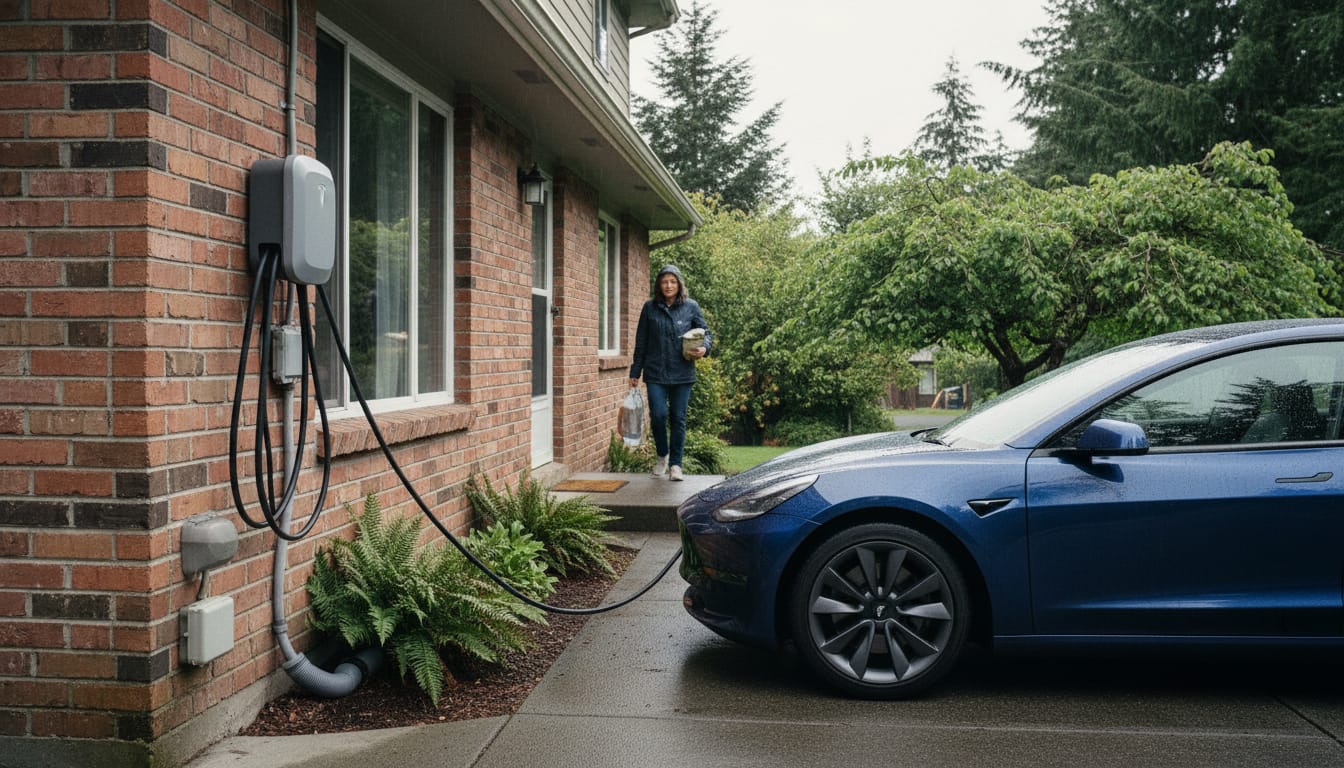
Where you park largely decides where your charger goes, and that location drives both the cost and the complexity of the install. This article walks through the common situations: attached garage, outdoors, a shared parking structure, and the most variable case of all, a detached garage. It also covers the one spec that matters most for any outdoor unit, the enclosure rating, and what cold weather actually does to a charger.
Indoor installation (attached garage)
Mounting a charger inside an attached garage is the simplest and least expensive option, and it is what most homeowners end up doing.
Why it is easier
- The cable run from the panel to the charger is usually short, and the panel is often in or near the garage.
- No outdoor weatherproofing is required beyond ordinary residential standards.
- Most jurisdictions allow a plug-in (NEMA 14-50) install in a garage without special requirements.
- The equipment is shielded from rain, sun, and temperature swings, which extends its useful life.
Typical cost range (as of Q2 2026): roughly $300 to $800 installed, assuming the panel has spare capacity and the run is short. Costs climb quickly once those assumptions break.
What to watch for
- If the panel sits on the opposite side of the house from the garage, the cable run gets longer and more expensive.
- An older or fully loaded panel may need a subpanel, a load calculation, or even a service upgrade before a 50- or 60-amp circuit can be added. That is often the single largest line item in a home charger project.
Outdoor installation
If you park in a driveway, under a carport, or at a detached garage, the charger has to live outside, or at least in an unheated, potentially wet spot. Five things move when the unit leaves the garage: the enclosure rating, the conduit, the connection type, the equipment lifespan, and the cost.
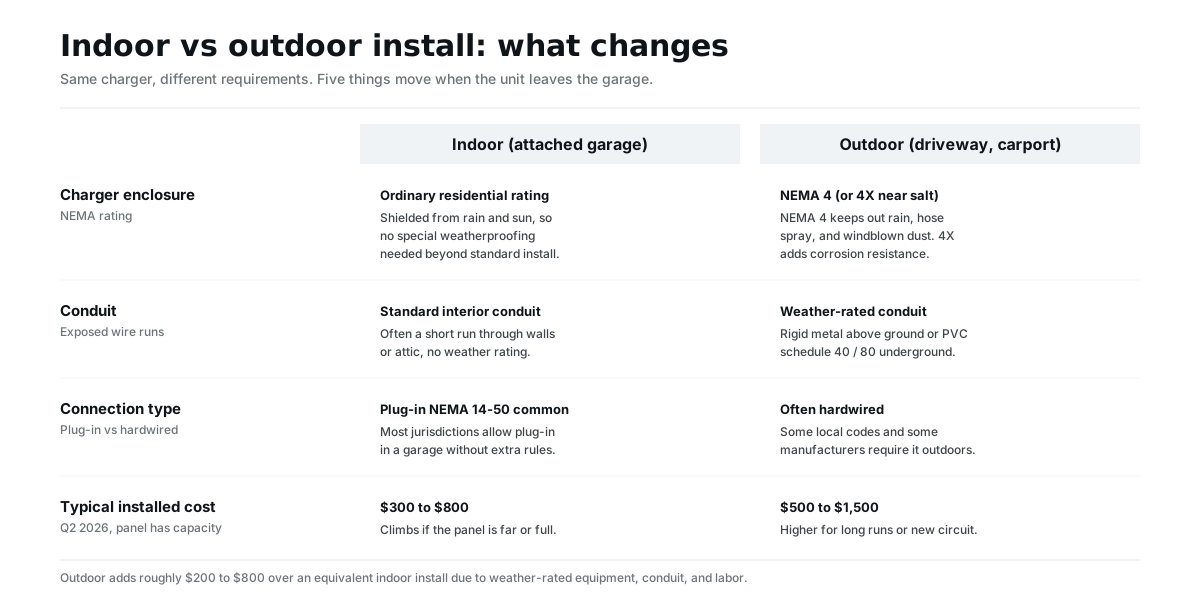
What to watch for
- A long run to a far driveway or detached garage may require trenching or an overhead run. Get this quoted specifically; it is the most variable cost in the whole project.
- Mount the unit out of direct standing water and, where possible, out of all-day direct sun, which can shorten the life of plastics and electronics.
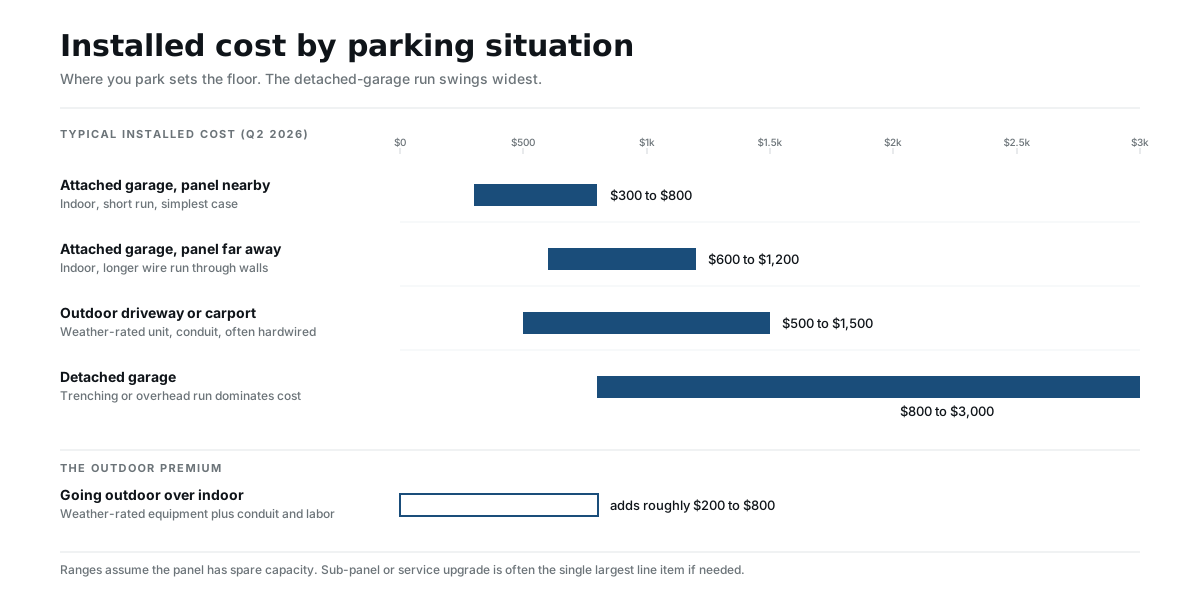
What outdoor installs cost by parking situation
Where you park largely sets the floor on cost. The detached-garage run swings widest because the panel-to-garage distance and trenching method dominate the bill.
The enclosure rating: the one outdoor spec to get right
Outdoor chargers are graded by their NEMA enclosure rating, which describes how well the housing keeps out water, dust, and corrosion. For most outdoor home installs, a NEMA 4 enclosure is the sensible target. NEMA 4X adds corrosion resistance worth specifying near the coast or anywhere salt exposure is a factor. NEMA 3R is acceptable basic outdoor protection but offers less margin against driving rain and hose spray.
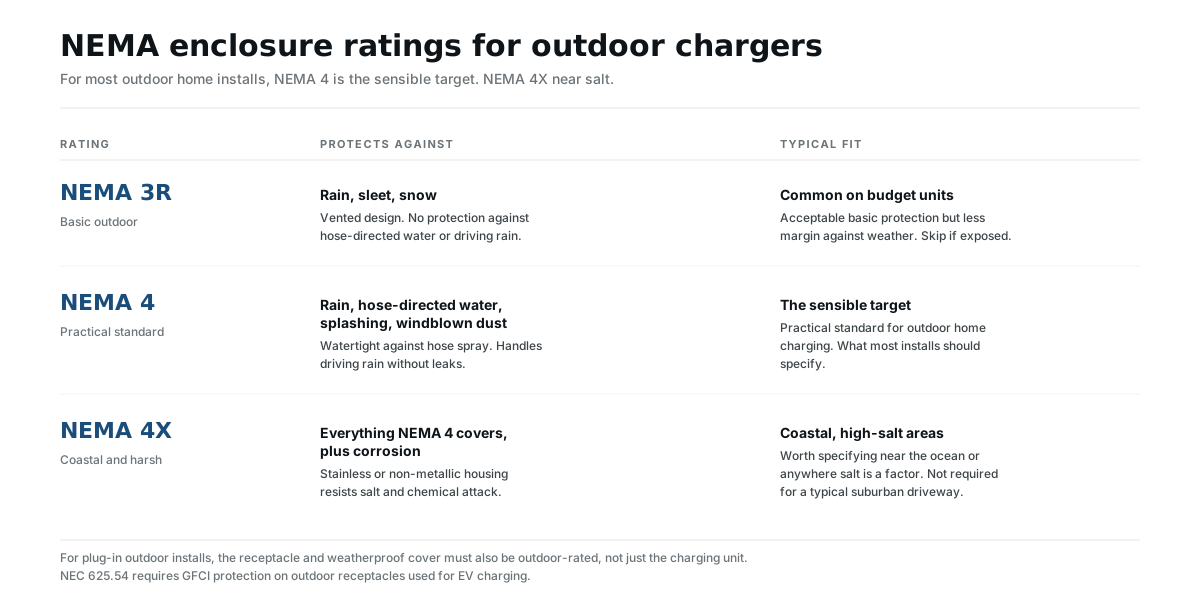
A practical note on receptacles: if you are doing a plug-in install outdoors, the receptacle and any weatherproof cover also have to be rated for the location, not just the charger. Confirm the full assembly is outdoor-rated, not only the charging unit.
Cold weather and your charger
Two cold-weather realities are worth planning for:
- Operating temperature range. Quality Level 2 home chargers are typically rated for a wide range; some units cite roughly -22°F to 122°F (about -30°C to 50°C). Check the spec sheet for the unit you are considering, especially if you are in a very cold or very hot region, and confirm the rated low temperature covers your winters.
- Cable stiffness. In hard cold, charging cables stiffen and become awkward to handle and coil. If you live somewhere with real winters, specify a charger with a cable rated for low-temperature flexibility. It is a small detail that makes daily use noticeably less annoying.
Cold weather also slows charging itself, because the car warms and conditions the battery before and during a charge. That is a vehicle behavior, not a charger fault, and it affects indoor and outdoor installs alike.
Condominiums and apartments
If your space sits in a shared structure, the install involves more than just you and an electrician.
Key considerations
- You typically need written approval from your HOA or building management.
- Many states have right-to-charge laws, but they come with procedural requirements; you cannot simply start drilling.
- The electrician's path from your unit's electrical supply to your space may cross common areas, which needs building permission.
- Some buildings already have EV infrastructure or are planning it. Check before you negotiate an individual install.
If the building does not allow individual installs, push for a shared Level 2 solution for residents. Some utility programs fund exactly this at low cost to the building.
Detached garage: the most variable case
A charger in a detached garage usually means running a new circuit from the home's main panel out to the garage. Depending on distance and site conditions, that can involve:
- Underground conduit (trenching), or
- An overhead run, and
- A subpanel in the garage if you want more than one circuit or a longer-term setup.
Typical cost range (as of Q2 2026): roughly $800 to $3,000, driven mostly by distance and local labor rates.
This is where getting multiple quotes matters most. The gap between a 30-foot run and a 150-foot run is large, and the trenching method (hand-dig versus machine, plus surface restoration) swings the price further.
Decision framework
| Your parking situation | Recommended approach |
|---|
| Attached garage, panel nearby | Plug-in NEMA 14-50, straightforward |
| Attached garage, panel far away | Still plug-in, but quote the longer run |
| Driveway or carport | Outdoor-rated unit (NEMA 4), often hardwired |
| Detached garage | Quote the panel-to-garage run first; it dominates the cost |
| Shared parking structure | HOA or building approval required; utility programs may help |
Checklist before you commit
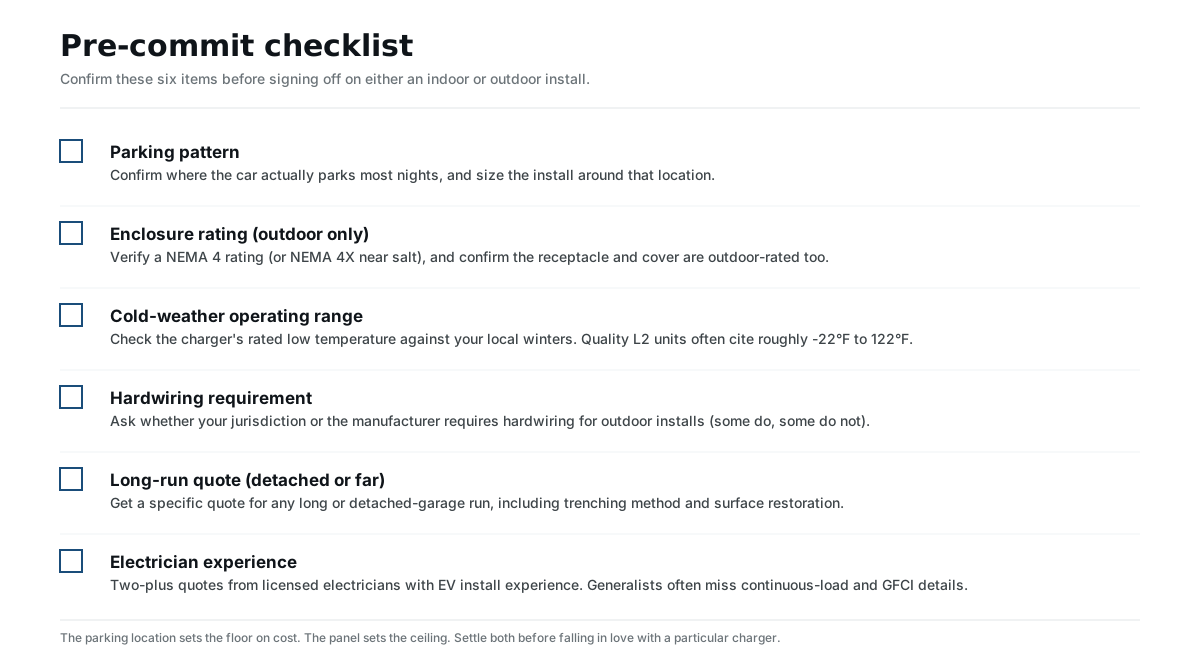
General electricians often are not familiar with the code details (continuous-load sizing, receptacle GFCI rules, enclosure ratings) that apply to EV installs. In every case, the parking location sets the floor on cost and the panel sets the ceiling. Settle both before you fall in love with a particular charger.
Last factually verified: 2026-05-24 against NEMA enclosure rating definitions (NEMA 3R, 4, and 4X) from NEMA Enclosures and Sonic Electric, EV charger outdoor-use and operating-temperature guidance from MetroEV and Solus Group, and the NEC receptacle GFCI requirement for EV charging (NEC 625.54).