Understanding the full cost of home EV charging means separating three things that often get blurred together: the charger hardware, the electrical installation, and the ongoing electricity to run it. Each behaves differently. The hardware is a known, fixed number. The installation is the wild card. The electricity is small but recurring, and it is where home charging quietly wins against gasoline. Here is an honest breakdown with current numbers (as of Q2 2026).
1. The charger hardware
Level 2 chargers for home use typically cost $250–$700 (as of Q2 2026). The unit itself is usually the smaller part of the total; installation is where the range widens.
| Charger | Price | Notes |
|---|
| Grizzl-E Classic | ~$259 | Hardwired, no app, durable |
| Emporia Smart EV Charger | ~$269–$319 | 48A, ENERGY STAR, app included |
| Grizzl-E Smart | ~$359 | Adds Wi-Fi and OCPP to the Classic |
| Tesla Wall Connector | $535 (Tesla list, Aug 11, 2026) | Best for Tesla owners; NACS connector |
| ChargePoint Home Flex | ~$599–$699 | 16–50A adjustable, ENERGY STAR, strong app |
| Wallbox Pulsar Plus | ~$699 | Power sharing for two-EV households |
Prices listed are typical manufacturer or retail figures and move with sales and supply. Confirm the current price before buying. For most drivers, the meaningful decision here is not price but whether you need smart features (scheduling, energy monitoring, utility program enrollment) or just a reliable box that delivers power.
2. Electrical installation
This is where budgets vary most: typically $400–$1,800 for a standard installation (as of Q2 2026), and more if your panel needs upgrading. Independent installation-cost guides put the all-in figure (hardware plus labor plus permit) at roughly $800–$2,200 for a typical home, with panel work as the main thing that pushes it higher.
What a standard installation includes:
- A new dedicated 240V circuit from your electrical panel
- A circuit breaker sized for the charger (commonly 60A for a 48A charger)
- The wire run from panel to charger location
- Charger mounting and wiring
- Permit and inspection fees (usually $75–$300)
Cost scenarios:
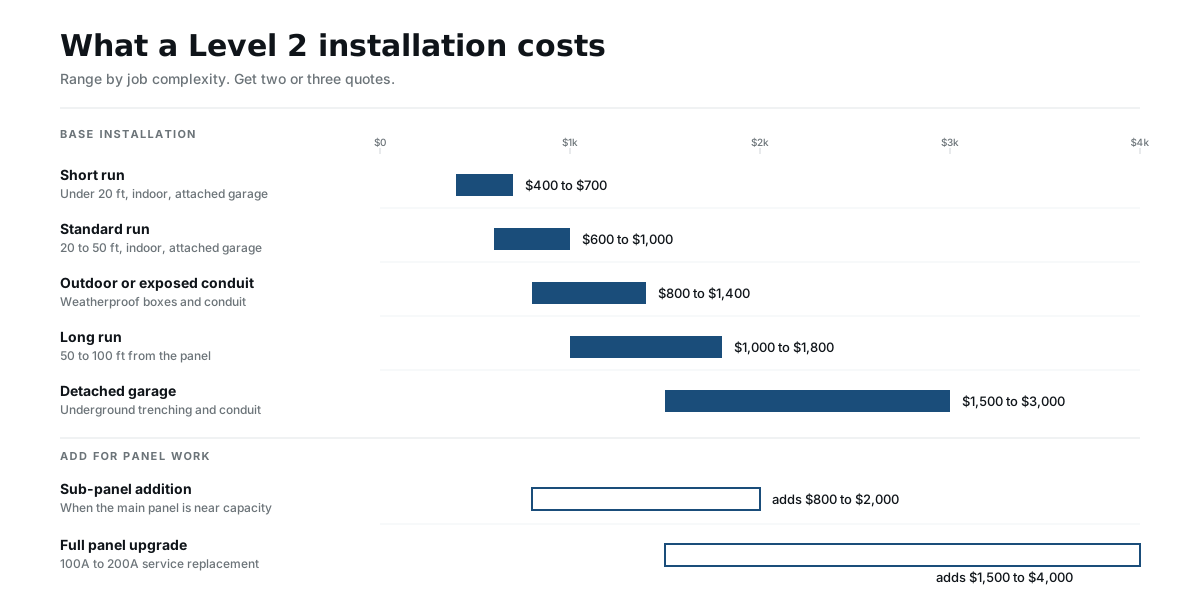
What drives the cost up:
- Distance from the panel to where you park (every extra 10 feet adds conduit and wire)
- Finished walls or attic runs that require fishing wire rather than surface-mounting conduit
- Outdoor exposure that requires weatherproof conduit and boxes
- Detached garages that need underground trenching
- Panels near capacity that require a sub-panel, a load-management device, or a full upgrade
The single biggest unknown before you get a quote is your panel. If you have an older 100A panel that is already close to full, the conversation can shift from a $700 job to a $3,000 job quickly. Our companion article on whether you need a panel upgrade walks through how to read your own panel before the electrician arrives.
3. Regional installation cost variation
Labor rates vary substantially by geography. The same installation that costs $600 in a mid-sized Midwest city can cost $1,200 in the San Francisco Bay Area or Seattle.
| Region | Labor cost relative to national average |
|---|
| Rural Midwest, South, Mountain West | 0.7–0.85× |
| Mid-sized cities (Columbus, Denver, Nashville) | 0.9–1.1× |
| Coastal metros (Boston, DC, Chicago, LA) | 1.1–1.4× |
| San Francisco Bay Area, NYC | 1.4–1.8× |
These multipliers are directional, not precise. The takeaway is simple: get two or three local quotes rather than trusting a national average. The spread between quotes in the same metro is often as wide as the regional difference.
4. Total upfront cost before incentives
| Setup | Charger | Installation | Total |
|---|
| Basic (simple charger, short run) | $259 | $550 | ~$810 |
| Mid-range (smart charger, typical install) | $649 | $900 | ~$1,550 |
| Complex (any charger, long or outdoor run) | $649 | $1,600 | ~$2,250 |
| With sub-panel addition | $649 | $2,200 | ~$2,850 |
| With full panel upgrade | $649 | $3,500 | ~$4,150 |
Most homeowners with a reasonably modern panel and an attached garage land in the $800–$1,600 range before any incentive.
5. Federal and state incentives
Federal 30C tax credit: ended June 30, 2026. The federal 30C charger credit (30% of your total out-of-pocket cost, charger plus installation, capped at $1,000 per item) ended June 30, 2026 and is no longer available. Equipment had to be placed in service (ready and available for use) by that date, not merely ordered or contracted, and the credit was always limited to homes in an IRS-designated "eligible census tract." Because the deadline has passed, plan on the real out-of-pocket cost rather than counting on a 30% credit. For the full background, see our dedicated article on the 30C credit that ended June 30, 2026 and the evergreen 30C explainer.
State and utility rebates: With the federal 30C credit gone, state and utility rebates are now the incentives that remain, and depending on where you live they can still meaningfully cut the cost. Amounts and availability vary widely by program, so we do not quote a fixed number here. Our guide on finding state and utility incentives explains exactly where to look and how to verify a program is still funded.
Illustrative example (historical, while the 30C credit was still available through June 30, 2026):
| Cost component | Amount |
|---|
| Charger hardware | $649 |
| Installation | $900 |
| Gross total | $1,549 |
| Federal 30C credit (30%) | –$465 |
| Example state or utility rebate | –$500 |
| Net out-of-pocket | ~$584 |
That stack was only reachable while the federal 30C credit existed. With 30C ended, the federal line no longer applies, so the same project nets about $1,049 out of pocket after the example rebate, and the rebate itself is illustrative, not a promise. Whether you get one depends on whether your utility or state has an active, funded program. In markets with no local rebate, the gross $1,549 is your number.
6. Ongoing electricity costs
This is the part most EV owners end up liking best once they see the math.
The formula:
(Monthly miles ÷ vehicle efficiency in miles per kWh) ÷ charging efficiency × electricity rate = monthly cost at the wall
The charging-efficiency term is there because your meter bills the energy that leaves the wall, not the energy that reaches the battery. FuelEconomy.gov reports charging efficiency typically around 84% to 93%, so treat the result as a range rather than one precise number. (If your efficiency figure is already measured at the wall, skip that division.)
EIA reports a May 2026 US residential average of 18.44 cents per kWh (EIA Table 5.6.A, checked against the published May 2026 table on August 11, 2026). Real-world EV efficiency for most passenger vehicles runs 3.0–3.5 miles per kWh, lower for trucks and large SUVs, higher for efficient compacts. We use 3.5 mi/kWh and round the rate to $0.18/kWh below. Your own rate may be far from the national average: EIA's May 2026 state averages ranged from 12.35 cents per kWh in Idaho to 52.00 cents in Hawaii, so the per-mile cost of charging swings widely by where you live.
| Monthly miles | kWh used (at 3.5 mi/kWh) | Cost at $0.18/kWh |
|---|
| 500 miles | 143 kWh | ~$26 |
| 750 miles | 214 kWh | ~$39 |
| 1,000 miles | 286 kWh | ~$51 |
| 1,250 miles | 357 kWh | ~$64 |
| 1,500 miles | 429 kWh | ~$77 |
These figures are battery-side; at 84% to 93% charging efficiency, the amount on your bill runs roughly 8% to 19% higher. The 1,000-mile row's $51, for example, lands between about $55 and $61 at the wall.
If you drive a less efficient vehicle (say 2.5 mi/kWh), multiply these numbers by about 1.4.
Time-of-use rates and the gasoline comparison
Many utilities offer reduced rates for overnight, off-peak electricity, often $0.07 to $0.13/kWh against peak rates that can run $0.20 to $0.40/kWh in high-cost markets. EVs are close to the ideal time-of-use customer because overnight charging is the natural default. You plug in when you get home and the car finishes by morning. The US average gasoline price was roughly $4.56 per gallon in late May 2026 (AAA; as of Q2 2026), the highest Memorial Day level in four years. Holding mileage at 1,000 miles per month, here is what those rate plans look like alongside a gas car.
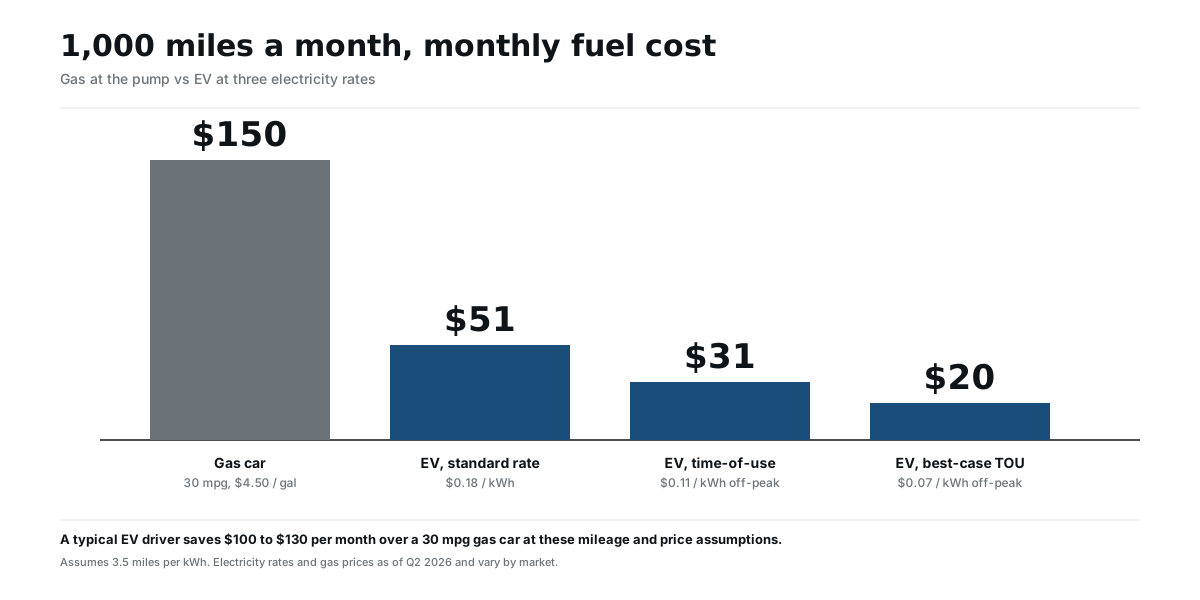
At roughly $100 to $130 per month in fuel savings, a $1,000 net installation cost pays back in under a year. Everything after that is recurring savings for the life of the vehicle. Note that gasoline prices in spring 2026 were unusually high; at a lower pump price the gap narrows but stays clearly in the EV's favor in nearly every market.
To capture the off-peak rates above, schedule charging to begin after the off-peak window starts (commonly around 9pm to midnight, ending around 6am to 8am), either through the charger's app or the car. Most Level 2 chargers with Wi-Fi support scheduled charging natively.
7. The hidden ongoing cost: electricity rate increases
Utility rates have risen meaningfully over the past several years; US residential rates climbed roughly 21% over the five years through 2026 (EIA data via industry trackers; as of Q2 2026). This matters for multi-year modeling.
If your electricity costs $0.16/kWh today, in five years at 4% annual increases it becomes about $0.19/kWh. That slightly erodes the per-mile advantage over time. But gasoline prices also rise, with more volatility, so the relative advantage of home charging tends to hold up.
The strongest hedge is on-site solar. If you have or plan to add rooftop solar, your marginal cost for daytime charging can approach zero. EV plus solar is a natural pairing that changes the long-run economics more than any rate plan.
8. Major utility time-of-use programs by region
If you are deciding whether to enroll in time-of-use pricing, here is roughly what off-peak rates and windows look like at several large utilities. Treat these as directional; rates and windows change on regulatory schedules.
| Utility | State | Off-peak rate (approx) | Off-peak window |
|---|
| PG&E (EV2-A plan) | CA | $0.23/kWh off-peak (price sheet effective March 1, 2026) | 12am–3pm |
| Southern California Edison (TOU-D-PRIME) | CA | $0.26/kWh summer off-peak, $0.24/kWh winter off-peak and super off-peak, plus a $0.79/day base charge (checked August 11, 2026) | 9pm–8am |
| Xcel Energy (EV plan) | CO/MN | $0.07–$0.09/kWh | 9pm–6am |
| ConEd (EV plan) | NY | $0.11–$0.13/kWh | overnight off-peak |
| Duke Energy (EV options) | NC/SC/FL | $0.06–$0.09/kWh | varies by plan |
| APS (EV rate) | AZ | $0.07–$0.10/kWh | 11pm–5am |
| Consumers Energy | MI | $0.08–$0.11/kWh | 11pm–6am |
California note: California has some of the highest electricity rates in the country, which makes its dedicated EV time-of-use tariffs (such as PG&E's EV2-A and SCE's TOU-D-PRIME) especially valuable. Without a plan that prices overnight charging lower, an EV in California can cost notably more to run than the national averages above. Even on these tariffs, California off-peak rates (23 to 26 cents per kWh on the plans above) sit well above the off-peak rates elsewhere in this table; their value is in avoiding peak-hour rates, which run far higher. If you live in California, checking your utility's EV-specific rate is still one of the highest-leverage things you can do.
Confirm current rates on your utility's website before enrolling. Most utilities let you switch to a time-of-use plan online in minutes; some require a smart meter if you do not already have one. Once your charger is installed, set a schedule that starts after the off-peak window begins so the savings happen automatically. For the step-by-step process of finding your own plan's exact window, whether it bills your whole house or just the charger, and the cold-morning scheduling tradeoff worth knowing about, see the best time to charge your EV at home.
9. Five-year total cost of ownership
Putting it together for a typical mid-range installation charging at a time-of-use rate (the net-cost figure below reflects the federal 30C credit that was available through June 30, 2026; without it the upfront cost is higher, though the multi-year electricity savings are unchanged):
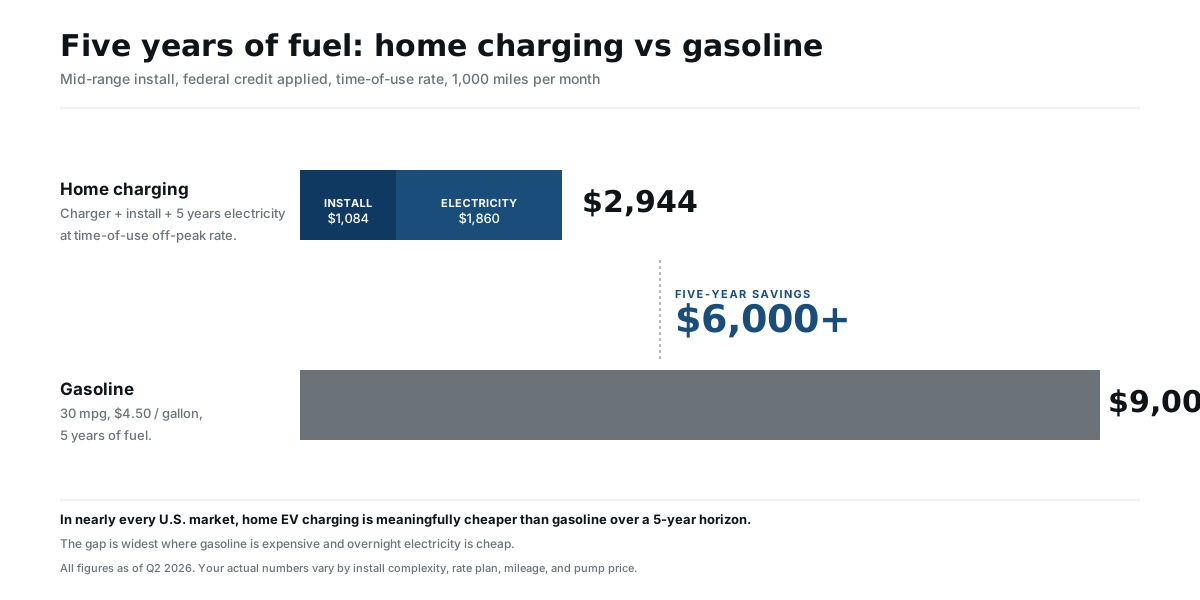
The exact figures depend on your install cost, your rate plan, your annual mileage, and the pump price over the period. The direction does not change: in nearly every US market, home EV charging is meaningfully cheaper than gasoline over a five-year horizon, and the gap is widest where gasoline is expensive and overnight electricity is cheap.
A short pre-quote checklist
Before you call an electrician, gathering a few facts will make your quotes faster, more accurate, and easier to compare.

Last factually verified: 2026-05-24, with electricity rate figures re-checked August 11, 2026 against EIA's published May 2026 Table 5.6.A (final monthly data are published after the month they cover): U.S. residential average of 18.44 cents/kWh, state averages from 12.35 cents in Idaho to 52.00 cents in Hawaii, and the multi-year rate trend of roughly 21% over five years. Also verified against AAA national gasoline price averages (about $4.56/gallon, late May 2026), independent 2026 Level 2 installation cost guides ($800–$2,500 typical all-in), EPA EV efficiency ranges, and the verified 30C facts in our dedicated 30C deadline article. Dollar figures marked "as of Q2 2026" reflect rates and prices current at that time and will drift; we log the verification date so you know whether this is current research or a stale page.
Corrections (August 11, 2026): This article previously cited a US average residential rate of about 17.65 cents per kWh, with state averages from under $0.09/kWh in North Dakota to over $0.33/kWh in Hawaii; EIA's published May 2026 data show 18.44 cents per kWh nationally, with state averages from 12.35 cents in Idaho to 52.00 cents in Hawaii. It also listed PG&E EV2-A off-peak at $0.12 to $0.16/kWh and SCE TOU-D-PRIME at $0.13 to $0.17/kWh, roughly half the actual rates; the correct figures are $0.23/kWh off-peak for PG&E EV2-A (effective March 1, 2026) and $0.26/kWh summer and $0.24/kWh winter off-peak and super off-peak for SCE TOU-D-PRIME, plus a $0.79 daily base charge.