The "levels" in EV charging (1, 2, and 3, though almost nobody calls the last one Level 3 anymore) describe how fast power flows into your battery. The differences are large, and they map directly onto how you'll actually live with an electric car. This piece explains what each level delivers in real-world terms, what it costs, which vehicles are compatible, and how to decide what you need at home.
The short version: Level 1 and Level 2 are home and workplace charging. DC fast charging is for the road. You can install Level 1 (you already have it) and Level 2 (with an electrician) at home. You cannot install DC fast charging at home, and you wouldn't want to.
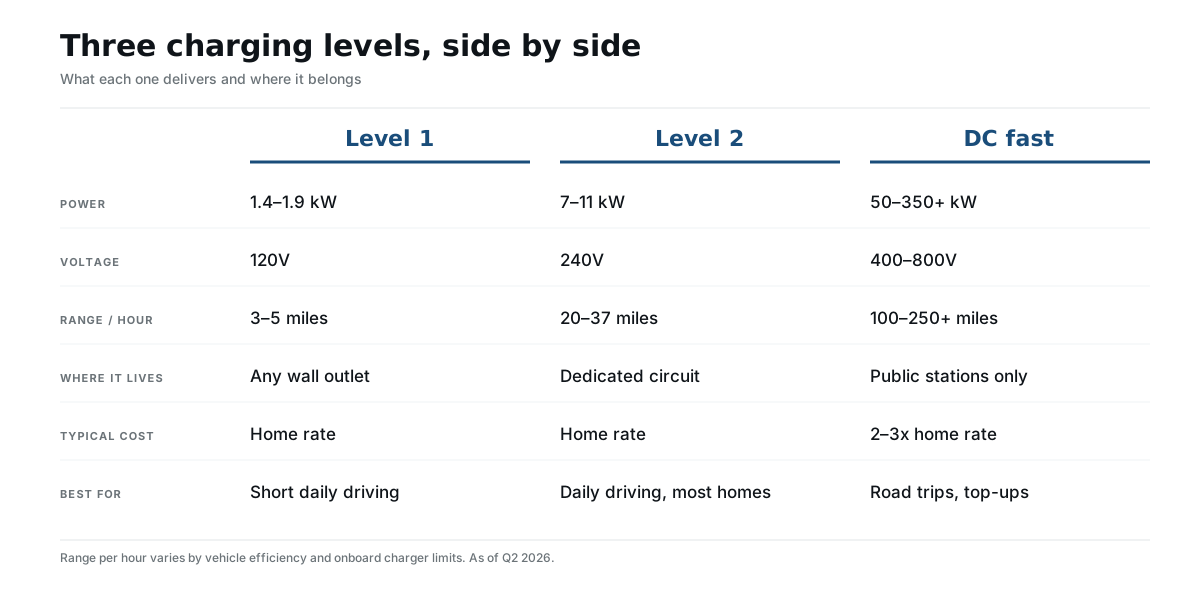
At a glance
Level 1: the outlet you already have
Level 1 charging uses a standard 120V household outlet, the same one your phone charger and toaster use. Every plug-in vehicle sold in the US ships with a Level 1 cable (the portable EVSE, sometimes called a "trickle charger"). No electrician, no equipment purchase, no permit. You plug into the wall.
What you get: roughly 1.4 to 1.9 kW of power, which adds about 3 to 5 miles of range per hour. Plugged in for a 10 to 12 hour overnight window, that is about 40 to 50 miles recovered. (as of Q2 2026)
Notice that this is a fixed rate. A bigger battery does not charge faster on Level 1; it just takes longer to fill from empty. Here is what that looks like across a few common vehicles, charging at a representative 1.4 kW.
| Vehicle | Battery (approx.) | Added overnight (12 hrs) | Full charge from near-empty |
|---|
| Tesla Model 3 (standard range) | ~57 kWh | ~50 miles | ~35–40 hours |
| Chevy Equinox EV | ~85 kWh | ~50 miles | ~50+ hours |
| Hyundai IONIQ 6 | ~77 kWh | ~50 miles | ~45+ hours |
| Ford F-150 Lightning (ext. range) | ~131 kWh | ~50 miles | ~80+ hours |
Battery sizes are approximate and vary by trim and model year. Charge times are illustrative.
The takeaway: Level 1 is a "top up what you used today" tool, not a "fill the tank" tool. That is fine if what you used today was modest.
When Level 1 is genuinely enough:
- You drive under about 30 to 35 miles on a typical day
- You can plug in nearly every night
- You drive a plug-in hybrid (small battery) rather than a full EV
- You are comfortable arriving home at, say, 40% and waking up around 80%
When Level 1 falls short:
- Daily mileage regularly over 35 miles
- An irregular schedule where some nights you forget or travel breaks the routine
- Two drivers sharing one car with different patterns
- A large-battery truck or SUV, where Level 1 barely keeps pace rather than rebuilding charge
A useful real-world test: live with Level 1 for two weeks before spending anything. If you are routinely waking up below 30%, it isn't keeping up, and that is your answer.
Level 2: the home charger most people end up with
Level 2 runs on a 240V circuit, the same voltage as an electric clothes dryer or range. It requires either a hardwired connection or a 240V outlet (commonly a NEMA 14-50), and either way an electrician installs it. We cover the install in detail in Home EV Charger Installation: What It Actually Involves.
What you get: roughly 7 to 11 kW, which translates to about 20 to 37 miles of range per hour, depending on the charger's amperage and your vehicle's onboard charger. (as of Q2 2026) That is enough to fully recharge most EVs overnight, every night.
Speed by amperage:
| Charger amperage | Breaker required | Approx. power | Miles added per hour |
|---|
| 16A | 20A | ~3.8 kW | ~10–12 miles |
| 32A | 40A | ~7.7 kW | ~20–25 miles |
| 40A | 50A | ~9.6 kW | ~25–30 miles |
| 48A | 60A | ~11.5 kW | ~30–37 miles |
Illustrative; actual miles depend on vehicle efficiency. As of Q2 2026.
One thing worth understanding: the charger and the car negotiate, and the lower of the two wins. If your vehicle's onboard charger accepts only 7.7 kW, a 48A (11.5 kW) wall unit will still only deliver 7.7 kW. Buying more amperage than your car can use does not speed up charging. We unpack this in Amperage and Charging Speed.
What Level 2 actually changes: it is less about raw speed and more about removing charging from your daily thinking. With Level 1 you manage a constraint. With Level 2 you plug in when you get home and wake up full, the way you charge a phone. For most households, that convenience, not a stopwatch number, is the reason to install it.
Cost: for most homes, a complete Level 2 install runs roughly $800 to $2,200 (as of Q2 2026), broken down as the charger unit ($300 to $900), electrician labor ($400 to $1,200), and permits ($50 to $300). Homes that need a panel upgrade or a long, difficult wire run can land well above that. The federal 30C tax credit used to return 30% of equipment and installation, up to $1,000, but it ended June 30, 2026 and is no longer available; it also required the home to sit in an IRS-eligible census tract. See our dedicated 30C article for the background.
DC fast charging (often called DCFC, or, less precisely, Level 3) sends DC power straight into the battery, bypassing the car's onboard charger entirely. That is why it is so much faster: 50 to 350+ kW, enough to take many EVs from roughly 10% to 80% in 20 to 40 minutes. (as of Q2 2026)
But it is public infrastructure, not a home product, and there are two reasons it stays that way.
First, the math of charging curves. EVs accept their peak rate only for part of the session, then taper sharply, usually past 80%. That is why DCFC sessions and pricing target the 10% to 80% band, and why "fill to 100%" at a fast charger is slow and wasteful of both your time and the station.
Second, frequent fast charging adds heat and stress to the battery. Most automakers advise against making it your primary method. Modern EVs with good thermal management (Tesla, the Hyundai/Kia E-GMP platform, GM's newer architecture) tolerate it well, but "Level 2 at home as the daily norm, DCFC for trips" remains the standard guidance.
The public networks (as of Q2 2026):
| Network | Connector | Max speed | Notes |
|---|
| Tesla Supercharger | NACS (J3400) | up to 250 kW | Largest and most reliable US network; now open to many non-Tesla EVs |
| Electrify America | CCS / NACS | up to 350 kW | Highway corridors, big-box retail; reliability much improved since 2022 |
| EVgo | CCS / NACS | up to 350 kW | Metro-focused; retail partnerships |
| ChargePoint | CCS / NACS | varies | Workplaces, garages, retail; less highway-centric |
What it costs: typically $0.30 to $0.55 per kWh (as of Q2 2026), roughly two to three times a home rate. A road-trip session that adds 150 to 200 miles often runs $15 to $30. Useful when you need it; expensive as a daily habit.
Why you cannot install it at home: even entry-level DC units start around 50 kW and need utility-grade service (often 480V three-phase) that residential properties do not have. Equipment alone starts in the tens of thousands of dollars. It is simply not a residential category.
A note on the NACS connector transition
If you are buying now, connectors are in transition, and it is worth understanding. SAE took up Tesla's connector as J3400, marketed as NACS: a Technical Information Report in December 2023, a Recommended Practice in 2024, and the J3400/2 connectors-and-inlets standard in May 2025. Since then, essentially every major automaker (Ford, GM, Hyundai, Kia, Rivian, BMW, Toyota, Honda, Mercedes, Nissan, and more) has committed to it, largely to give customers access to the Supercharger network. New models began shipping with native NACS ports starting with the 2025 model year. (as of Q2 2026)
In practice, 2026 is a hybrid grid: NACS is winning, but CCS hardware is still everywhere. A CCS-port car can use Superchargers with an adapter; a NACS-port car can use older CCS stations with the opposite adapter. None of this changes your home charging. Home Level 2 connectors are interchangeable via the cable, and the adapter situation only matters at public fast chargers. Buy the home charger that fits your car's port, or a unit with a swappable cable.
Cost per mile: all three compared
Assuming a reasonably efficient EV at about 3.5 miles per kWh:
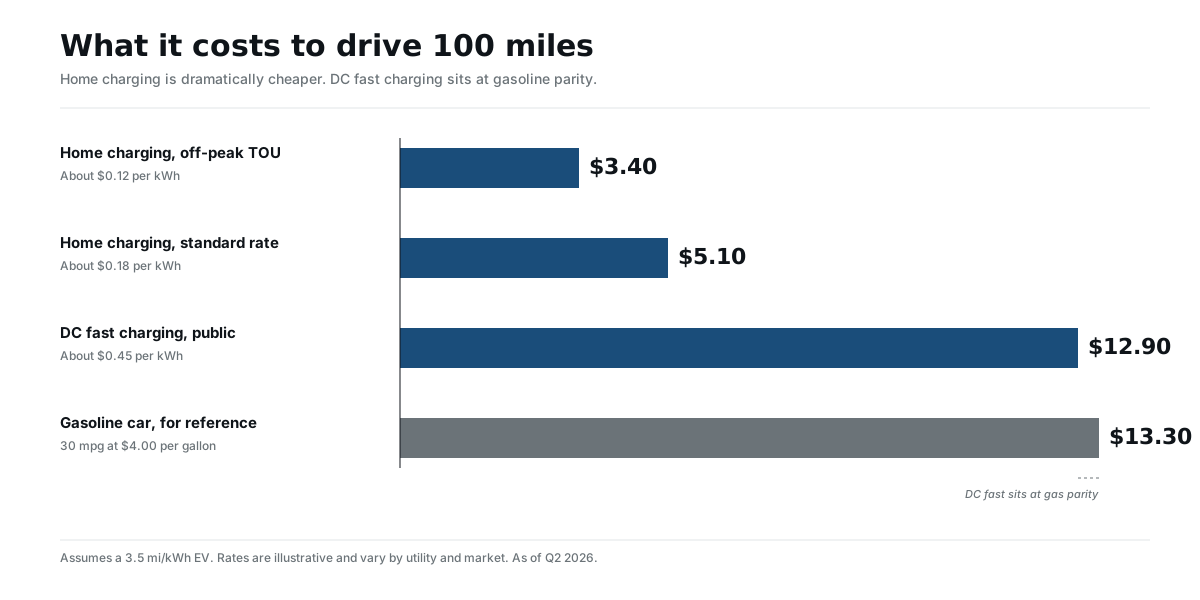
The pattern is clear. Charging at home, on Level 1 or Level 2, is dramatically cheaper per mile than gasoline. DC fast charging is roughly gasoline-priced per mile, which is exactly why it belongs to road trips rather than daily life.
California note: the home-rate advantage is biggest where time-of-use plans exist, which includes most of California. PG&E, SCE, and SDG&E all offer EV-specific TOU rates with low overnight prices and higher daytime/evening prices. (PG&E's EV2-A structure shifts in March 2026; confirm current pricing with your utility.) On those plans, overnight Level 2 charging is the cheapest fuel you will ever buy, while daytime charging at the wrong rate can erase much of the savings. If you are in California, the right rate plan matters as much as the charger.
Which one do you actually need?
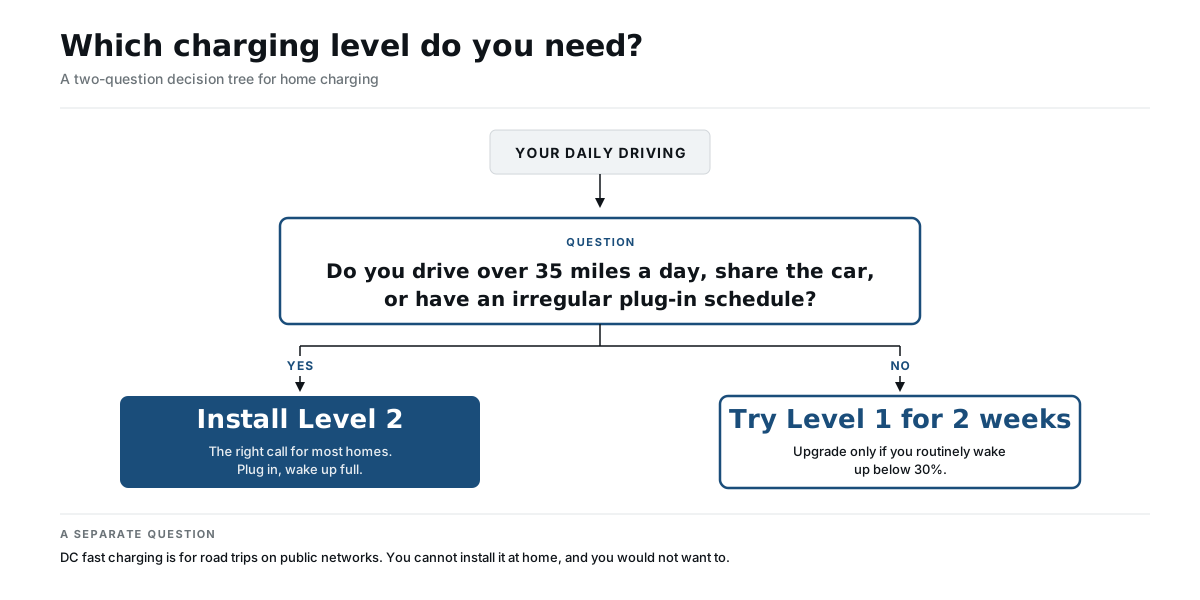
Most homeowners who start on Level 1 move to Level 2 within the first several months. If you already know you drive more than a short commute, getting ahead of that decision, ideally before the car arrives, is almost always the right move. For public-network road trips, plan with PlugShare or A Better Route Planner, or your car's built-in navigation. For a fuller walk-through of the Level 1 vs Level 2 judgment, see Do You Really Need a Level 2 Charger?.
Last factually verified: 2026-05-24 against U.S. Department of Transportation EV charging-speed guidance, U.S. News and SAE-derived NACS/J3400 transition reporting, Electrify America published charging speeds, 2026 Level 2 installation cost surveys, and California utility (PG&E/SCE/SDG&E) EV rate information.