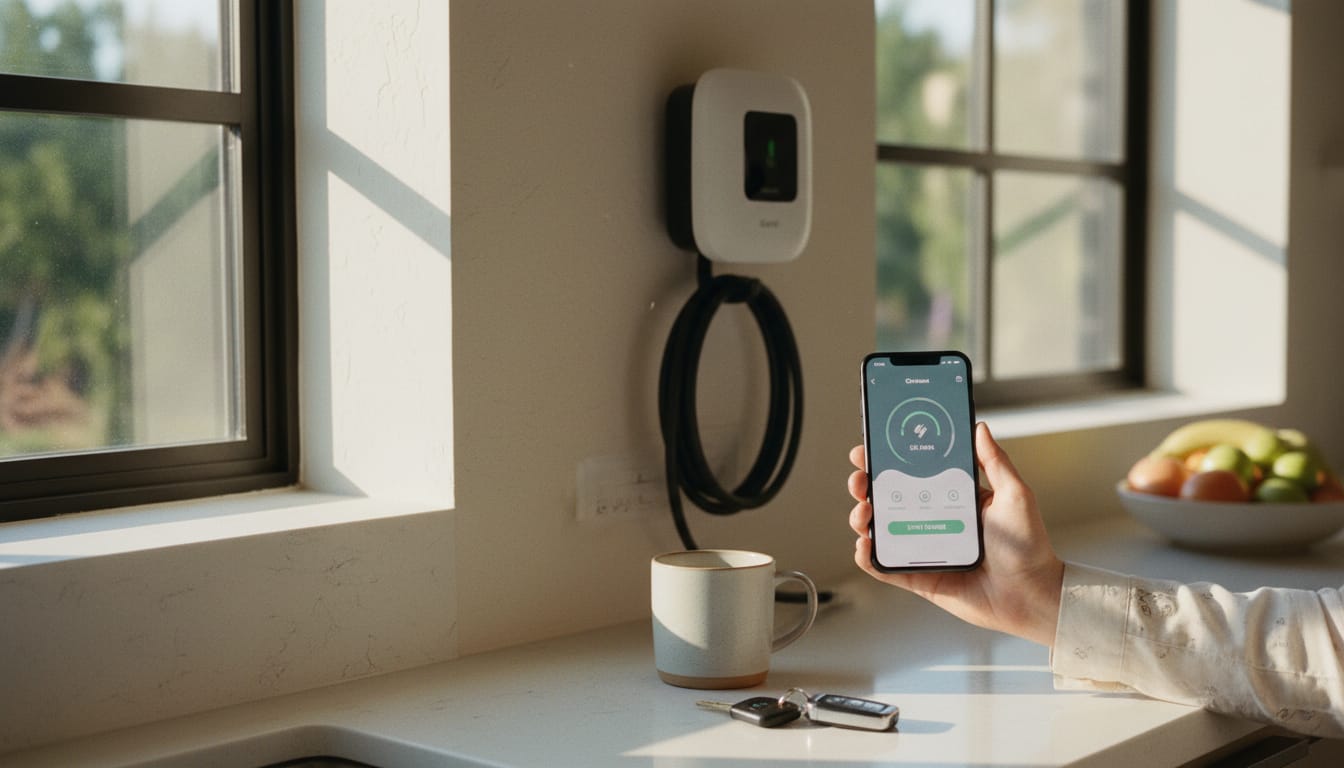
The ChargePoint Home Flex is the home charger most buyers end up recommending to each other, and the reasons hold up under scrutiny. It works across a wide range of homes, vehicles, and electrical setups without forcing you to give up features that matter. It is not the cheapest option, and it is not the fastest, but for a buyer who wants to install once and stop thinking about it, it is hard to go wrong.
This is an independent assessment. We have no affiliate or referral relationship with ChargePoint or any other manufacturer mentioned here, and the specs below were verified against ChargePoint's own documentation in May 2026.
What makes it stand out
Adjustable amperage from 16 to 50 amps. This is the Home Flex's defining feature. During setup the unit is configured to match your circuit, with selectable output at 16, 24, 32, 40, 48, and 50 amps. That flexibility matters more than it sounds. If your panel only has room for a 30- or 40-amp breaker, you set the charger to match and avoid a service upgrade. Many competitors ship at a fixed rating, so you either oversize the circuit or live with a mismatch. (Specs as of Q2 2026; confirm against ChargePoint's current datasheet.)
Works with every EV. ChargePoint sells the Home Flex with either a J1772 or a NACS connector, across hardwired, NEMA 6-50, and NEMA 14-50 configurations, so you can match the port on your car directly. J1772 is the long-standing standard for AC Level 2 charging in North America, and every non-Tesla plug-in vehicle, including plug-in hybrids, accepts it directly. Vehicles with a NACS (SAE J3400) port, which now includes most new Teslas plus a growing list of Ford, GM, Rivian, Hyundai, and Kia models, can use the NACS version, or charge from the J1772 version through a NACS-to-J1772 adapter. ChargePoint also sells a NACS cable-conversion kit for eligible existing Home Flex units. See our note on the NACS transition below.
ENERGY STAR certified. This is not a marketing footnote. Many utility rebate programs require ENERGY STAR certification as a condition of the rebate. The Home Flex qualifies, which means it clears a gate that disqualifies several otherwise-capable chargers.
A mature app. ChargePoint has run a public charging network for well over a decade, and the consumer app reflects that history. You get charge scheduling (useful for shifting load to off-peak rates), energy-use tracking, charging history, and remote start and stop. There is no subscription required for these home features.
Indoor and outdoor rated. The Home Flex carries a NEMA 3R enclosure rating, which covers typical outdoor wall mounting in a garage, carport, or exterior wall.
Specifications
| Spec | Value (as of Q2 2026) |
|---|
| Amperage settings | 16, 24, 32, 40, 48, 50A |
| Max power | 12 kW (240V, 50A) |
| Connector | J1772 or NACS; conversion kit available for eligible existing Home Flex units |
| Installation | Hardwired or plug-in (NEMA 14-50 or NEMA 6-50) |
| Cable length | 23 feet |
| Outdoor rating | NEMA 3R |
| Wi-Fi / app | Yes, no subscription for home features |
| ENERGY STAR | Yes |
| Warranty | 3 years |
Pricing has historically run in the $600 to $700 range depending on configuration and where you buy, but charger prices move with promotions and supply, so check the current price at ChargePoint or an authorized retailer before you commit. We do not quote a single figure because it goes stale quickly.
The plug-in vs. hardwired decision
The Home Flex supports both hardwired installation and plug-in installation using a NEMA 14-50 or NEMA 6-50 receptacle.
Hardwiring lets the unit run at its full 50-amp output and is the cleaner permanent install. Plug-in installation is capped at 40 amps, because that is the safe continuous draw for a standard NEMA 14-50 outlet under code, and it has two practical advantages: it is often cheaper to install (an outlet rather than a dedicated connection to the unit), and the charger can come with you if you move.
For most vehicles, 40 amps is more than enough to fully recharge overnight. The extra speed from 50-amp hardwiring only matters for vehicles with larger onboard chargers and for drivers who routinely return home with a nearly empty battery and a short window before the next trip. For a fuller treatment, see our piece on amperage and charging speed.
A note on the NACS transition
The connector landscape is shifting. Through 2025 and 2026, nearly every major automaker moved to the NACS (SAE J3400) port, and most new EVs now ship with NACS rather than J1772. That does not force a choice on Home Flex buyers: ChargePoint sells the unit with either connector, and a NACS cable-conversion kit can update eligible existing Home Flex stations. A NACS-equipped car also charges fine from a J1772 unit through an adapter, and AC Level 2 charging at home is exactly the case adapters handle well. The Home Flex remains a reasonable choice; just order the connector that matches your household, and know that the conversion kit or an adapter covers you if your next car changes ports.
What it doesn't do as well
No built-in cable management. The cable hangs from the unit. Some owners add an inexpensive third-party hook; others let it hang. It is a minor inconvenience, not a defect, but at this price point a holster would be nice.
App connectivity quirks. ChargePoint's app has, at times, shown a charger as offline even while it is charging normally. This is usually cosmetic rather than functional, and firmware updates have improved it, but if you want a charger that never makes you second-guess a status icon, this is worth knowing.
No power sharing. The Home Flex does not automatically balance load between two units on a shared circuit. A two-EV household that wants both cars on one circuit without a panel upgrade is better served by a charger built for that, such as the Wallbox Pulsar Plus or paired Tesla Wall Connectors.
Price. It sits at the higher end of residential chargers. If you do not need the app, the ENERGY STAR rebate eligibility, or the adjustable amperage, a simpler unit like the Grizzl-E Classic does the core job for noticeably less.
Who it's for
The buyer who wants to choose once and forget it. If you want a charger that fits your current EV, will fit your next one, qualifies for utility rebates, and has a functional app, the Home Flex covers all four.
Buyers in utility rebate programs. The ENERGY STAR certification clears a requirement that trips up several competing chargers.
Renters with landlord permission, or owners who expect to move. The plug-in version travels. Have the landlord install the outlet and take the charger when you go.
Who should skip it
Two-EV households on a tight panel. A power-sharing setup will use your existing circuit more efficiently. The Wallbox Pulsar Plus is the more natural fit.
Buyers who want the simplest, lowest-cost durable unit. If you do not value the app or rebate eligibility, the Grizzl-E Classic does the basic job well for less money.
Drivers who want Tesla-native app integration. An all-NACS household no longer needs to look elsewhere, since ChargePoint sells the Home Flex with a NACS connector. But a Tesla household that wants charging scheduled through the Tesla app is still better served by a Tesla Wall Connector.
For how the Home Flex compares against the rest of the field, see our overview of home EV chargers worth considering, and our reviews of the Tesla Wall Connector and the Wallbox, JuiceBox, and others lineup.
Last factually verified: 2026-05-24 against ChargePoint Home Flex product and installation documentation (chargepoint.com), the ChargePoint Home Flex datasheet, and ChargePoint's warranty policy; connector availability re-checked August 11, 2026 against ChargePoint's current Home Flex page. Pricing changes frequently; verify current pricing directly with the manufacturer or an authorized retailer. We have no affiliate or referral relationship with any charger manufacturer; this assessment reflects independent judgment.
Corrections (August 11, 2026): This review previously described the Home Flex as J1772-only, with NACS vehicles relying on an adapter. ChargePoint offers the Home Flex with either a J1772 or a NACS connector, across hardwired, NEMA 6-50, and NEMA 14-50 configurations, and sells a NACS cable-conversion kit for eligible existing Home Flex units.